

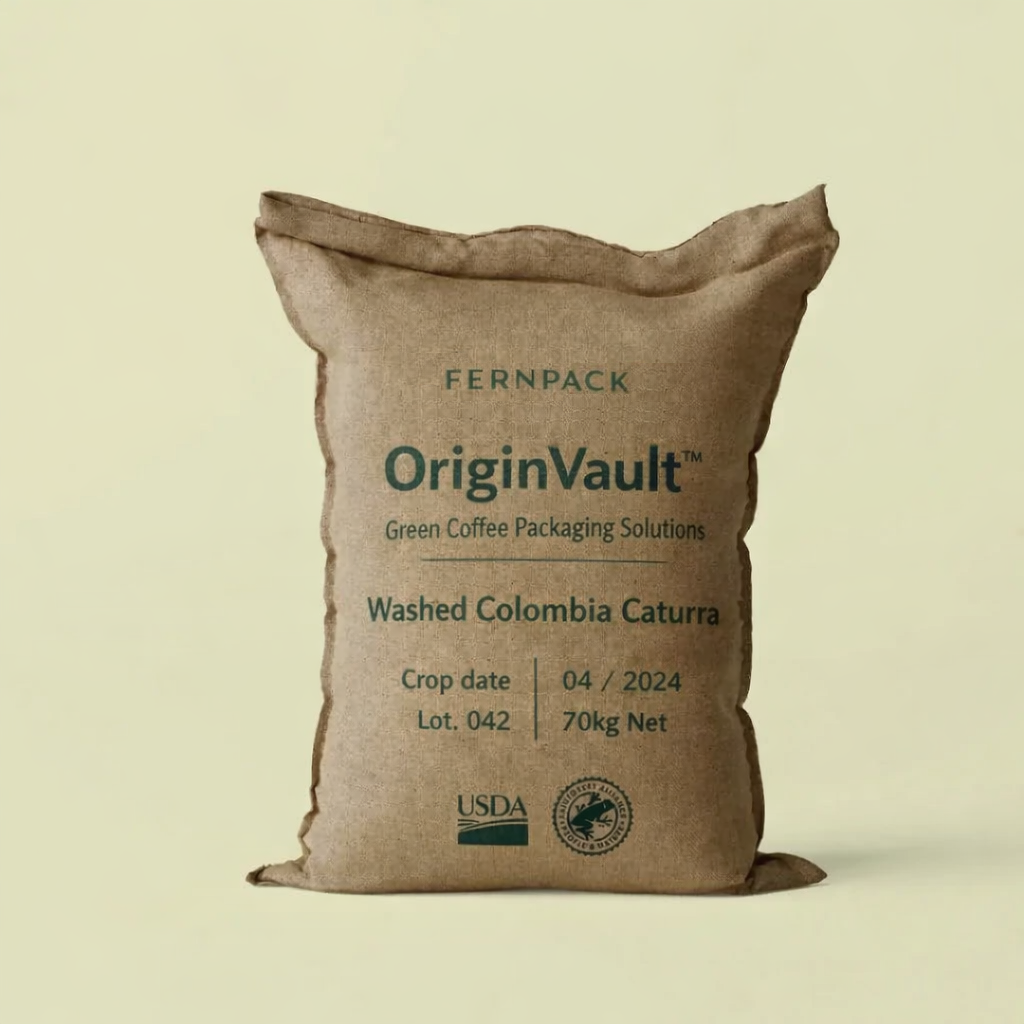
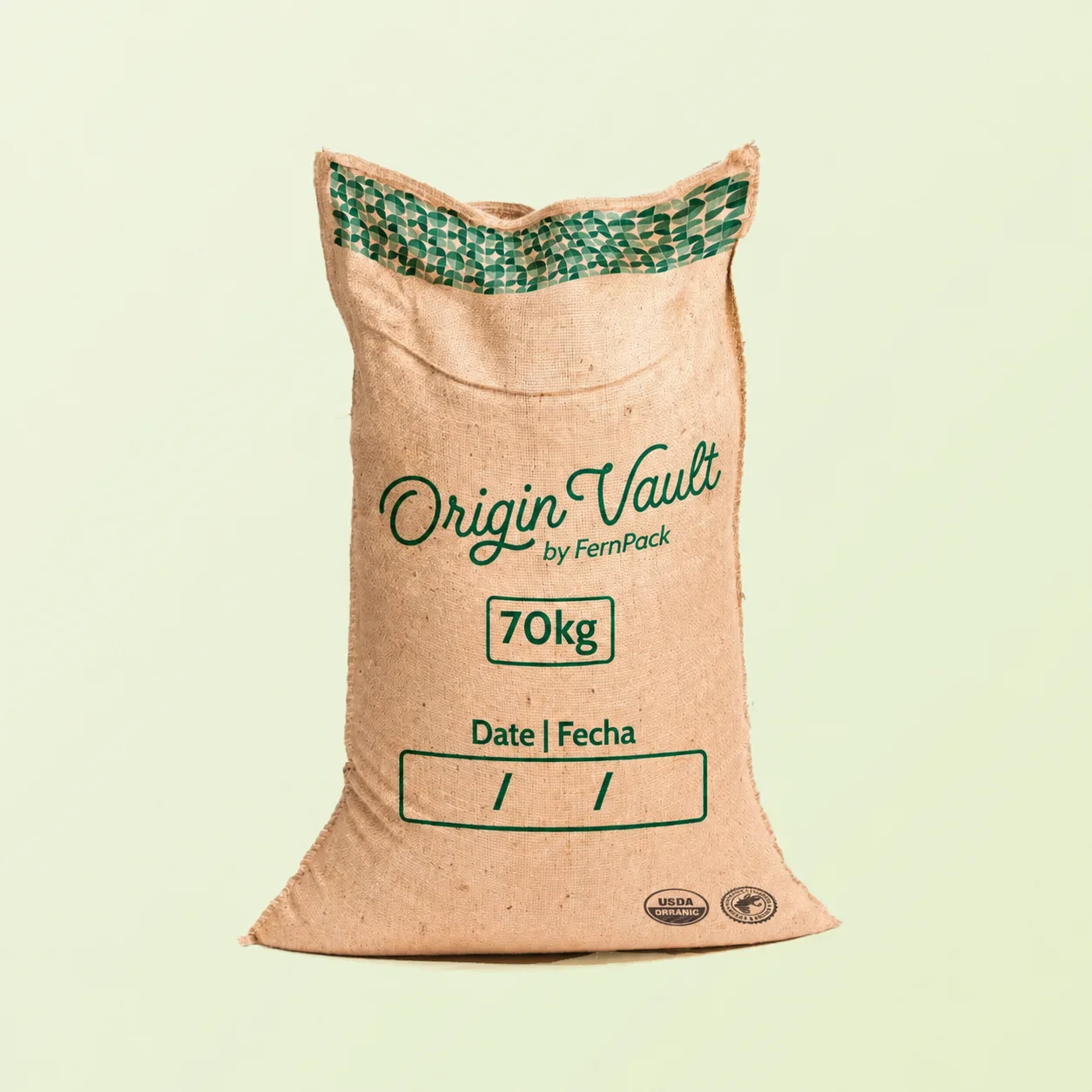
Jute bags remain a standard outer packaging format in green coffee logistics, widely used across origin, export, and import handling. FernPack’s jute bags are designed to support the physical movement, storage, and identification of green coffee throughout the supply chain, rather than serving as a primary barrier for quality preservation.
Constructed from heavy-duty natural fiber, these green coffee jute bags provide the structural strength required for loading, stacking, and container transport. Their woven structure allows a degree of airflow, which can help reduce condensation during short-term handling or transitional storage stages. In most export scenarios, they are used in combination with inner liners such as vacuum bags or hermetic liners, which take on the role of moisture and oxygen protection.
In warehouse and port environments, jute bags function as a reliable handling unit. They support lot separation, simplify manual handling, and enable clear visual identification of origin, crop date, and lot information. This is particularly relevant for microlot shipments and auction coffees, where traceability and presentation are critical during buyer inspection and transfer.
For exporters and importers, compatibility with standard palletization and container loading is essential. These bags are sized and constructed to align with typical 60–70 kg green coffee logistics formats, allowing efficient stacking while maintaining structural integrity under compression.
Printing options can be applied directly to the bag surface, including origin details, lot codes, and handling instructions. This supports traceability across multiple touchpoints, from origin warehouses to destination roasters.
Jute bags are not intended to replace barrier packaging. Instead, they operate as the outer layer in a multi-layer packaging system, working alongside inner liners to ensure both logistical efficiency and quality protection.
Frequently Asked Questions
1. What is the typical role of jute bags in green coffee packaging?
Jute bags are primarily used as the outer packaging layer in green coffee logistics. They facilitate handling, stacking, and lot identification, while inner liners are typically used to manage moisture and oxygen exposure.
2. Are jute bags used alone or with inner liners?
In most export scenarios, jute bags are used together with inner liners such as vacuum or hermetic bags. The liner protects the coffee quality, while the jute bag provides structural support for transport and handling.

Reviews
There are no reviews yet.