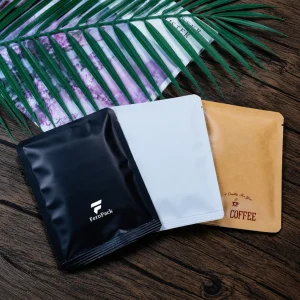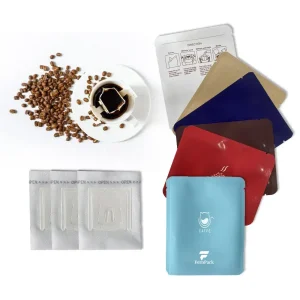
When sourcing custom coffee bags, MOQ is usually one of the first numbers buyers ask about. A supplier may quote a minimum of 500, 1,000, or 10,000 bags depending on the project and production method, and it is tempting to use that number as the starting point for the purchase. In reality, MOQ answers a much narrower question: what is the smallest quantity the supplier is prepared to produce? It does not tell you whether that quantity will last until your next shipment arrives, whether a somewhat larger order would have much better production economics, or whether buying enough to reach the lowest unit price would leave you with far more packaging than you can realistically use.
This distinction matters because custom coffee bags are both a production purchase and an inventory commitment. A small order gives you flexibility but may carry a higher unit cost and require more frequent replenishment. A large order can improve production economics, but it also commits more cash to packaging printed with today’s artwork, product information, and assumptions about future demand. The right quantity is therefore rarely found by looking at MOQ or unit price alone. It sits somewhere between the amount of packaging you need to operate safely and the amount of inventory you are comfortable carrying.
A more useful way to approach the decision is to start with your own consumption and replenishment cycle, establish a realistic range of quantities, and then use the supplier’s production economics to decide where inside that range the order makes sense. This turns the question from “What is your coffee bag MOQ?” into something much more useful: “Within the quantities my business can realistically use, where does ordering more actually create enough value to justify the additional inventory?”
What does coffee bag MOQ actually tell you?
MOQ stands for minimum order quantity. For custom coffee bags, it is the lowest quantity a supplier is prepared to manufacture under a particular production setup. There is no universal coffee bag MOQ because different production methods become practical at very different quantities. At FernPack, suitable digital printing projects can start from 500 bags in total, while gravure printing typically starts from 10,000 bags per design. These are not simply different quantity breaks for the same production process. Digital and gravure printing have different setup requirements and production economics.
Bag size, material, number of designs, and finishing requirements can also affect where production starts. Different suppliers may use different equipment and processes, so two very different MOQs do not necessarily represent comparable production offers. A published “500-piece MOQ” therefore cannot be compared meaningfully with another supplier’s MOQ unless you also know what printing method, bag specification, and design configuration that quantity applies to.
What coffee bag MOQ tells you is where production can start; it does not tell you where the economics become attractive or how much packaging your business should buy. For example, in a small digital-printing run, a supplier may be able to produce 500 bags while 1,000 costs only moderately more in total. At a larger quantity, the unit price may continue to fall, but the buyer also has to carry more inventory. The lowest unit price is therefore not automatically the most economical purchasing decision.
The purchasing decision has to reconcile three things: the minimum the supplier can produce, the quantities where production costs improve, and the amount of packaging your business can realistically consume. To find that amount, it is more useful to start with your own demand and replenishment cycle than with the supplier’s MOQ.
Find your practical purchasing range
A useful quantity decision starts with the amount of packaging the business actually consumes. Suppose a roaster uses approximately 500 bags per month. If the complete replenishment cycle from placing a purchase order to receiving usable stock takes around six weeks, roughly 750 bags could be consumed while the next order is being produced and delivered. Ordering only 500 bags would therefore create a very tight cycle even if 500 is technically the supplier’s MOQ. The business could find itself preparing the next purchase almost as soon as the previous shipment arrives, with little room for higher-than-expected sales or a logistics delay.
The replenishment period should include more than factory production time. For imported coffee packaging, the practical cycle includes production, international transport, customs or final delivery, and whatever operating buffer the buyer considers reasonable. At FernPack, production is typically around 10–15 days for digital printing and 20–30 days for gravure printing, but those figures do not include transportation to the customer’s warehouse. A buyer using sea freight to Europe or North America therefore has a very different inventory requirement from one replenishing locally or using express delivery.
The 750 bags in this example should not be treated as a universal minimum order quantity. It is simply a useful reference for the amount of packaging that may be consumed during replenishment. The actual order also depends on when the next PO is placed, how much inventory remains at that point, and how much safety stock the business wants to maintain.
That consumption-and-replenishment calculation gives you a useful lower boundary, but you also need an upper one. If the same roaster uses 500 bags per month and is comfortable holding no more than about six months of printed packaging, the inventory ceiling would be around 3,000 bags. The precise number is not important; what matters is that the business has now replaced an open-ended MOQ discussion with a realistic purchasing range. Instead of asking whether it should buy the supplier’s 500-piece minimum or chase a much lower price at 5,000 pieces, it can focus on quantities somewhere between the stock required for safe replenishment and the maximum inventory it is willing to carry.
For this example, 1,000, 2,000, and perhaps 3,000 bags become meaningful quantities to compare. An offer for 10,000 pieces may have an excellent unit price, but it is outside the business constraint before the quotation is even considered. This is an important shift in purchasing logic: the supplier’s production capabilities should help you choose within a range that makes sense for your business, rather than define that range for you.
Where does ordering more actually save money?
Once a practical purchasing range has been established, production economics become useful. Custom packaging costs rarely fall in a straight line as volume increases because some production costs are relatively fixed while others vary with quantity. Moving from a small run to a moderate run can therefore produce a significant improvement in cost per bag, while increasing the quantity again may deliver a much smaller incremental saving. The lowest unit price is usually found at the largest quantity, but that does not mean every increase in quantity creates the same economic value.
Take the same roaster using 500 bags per month. For a project being considered for digital printing, a quotation for 1,000 bags represents roughly two months of demand, 2,000 bags represents four months, and 5,000 bags represents ten months. If moving from 1,000 to 2,000 produces a meaningful reduction in unit cost, the buyer is exchanging two additional months of inventory for that saving. Moving from 2,000 to 5,000 means taking on another six months of inventory for the additional unit-cost saving. Even if 5,000 has the lowest price per bag, it is only the better purchase if that additional saving is worth carrying the extra 3,000 bags.
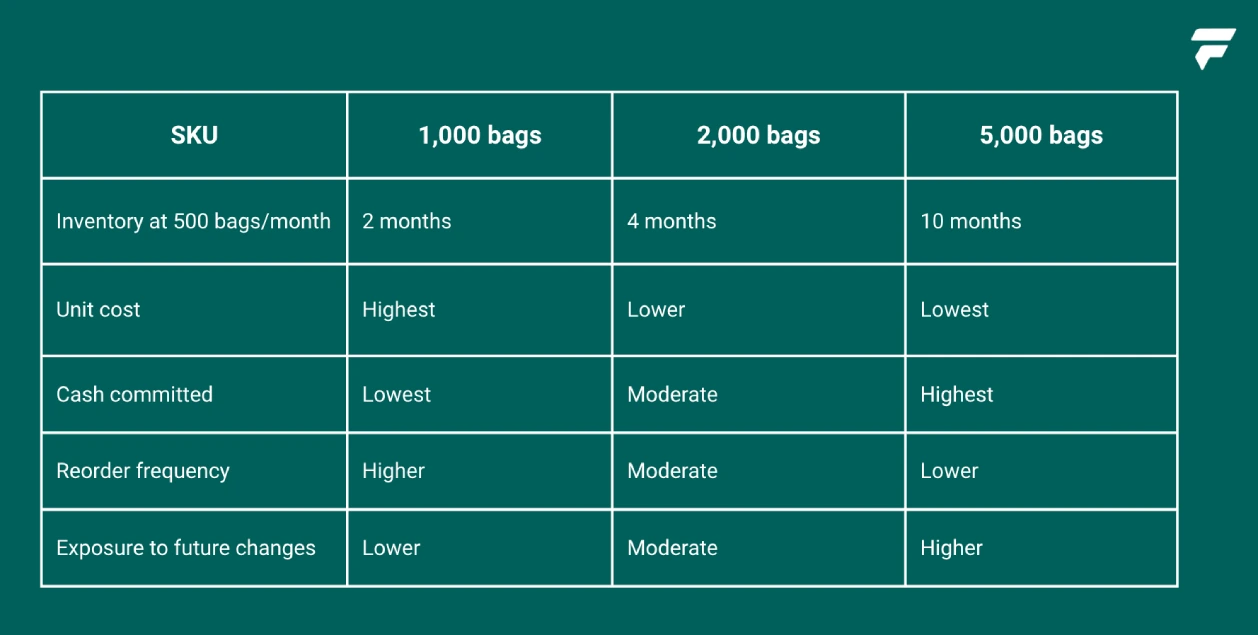
The same purchasing logic applies at much larger volumes. Suppose an established roaster uses 8,000 bags per month of one stable design and is evaluating gravure production. A 10,000-bag order represents about 1.25 months of demand, 20,000 bags about 2.5 months, and 30,000 bags about 3.75 months. A 30,000-bag production run may sound large in isolation, but for this buyer it represents less than four months of stock.
If the cost improvement from 10,000 to 20,000 is substantial while the move from 20,000 to 30,000 produces only a modest additional saving, the buyer can evaluate those steps in exactly the same way as in the smaller digital-printing example: how much additional inventory is being accepted for each additional reduction in unit cost? The quantities are larger, but the purchasing question is the same.
This is why 10,000 or 30,000 bags cannot be labelled “too large” simply by looking at the quantity. For a roaster using 500 bags per month, 10,000 bags represents twenty months of demand and would usually require a strong reason to justify that inventory commitment. For a mature SKU using 8,000 bags per month, the same 10,000 bags represents only about five weeks of demand. A coffee bag MOQ therefore becomes useful for purchasing decisions only when it is viewed together with the production method and the rate at which the buyer will actually consume the packaging.
The useful comparison is not simply the unit price at each quantity, but the incremental saving against the incremental inventory required to obtain it. A larger order makes sense when the next increase in quantity still creates meaningful savings and the additional stock will turn over comfortably. When each further price reduction requires disproportionately more inventory, the lowest unit price may no longer represent the best purchasing decision.
Digital and gravure printing have different production economics as quantities increase, so the most suitable production method can also change with order volume, number of designs, and repeat purchasing pattern. If you are still deciding which production route fits your project, see our guide to digital vs. gravure printing for coffee bags. For the quantity decision here, the distinction is simpler: the printing method shapes the production economics, while your consumption rate determines what those production quantities mean for your inventory.
Why total volume can mislead multi-SKU coffee roasters
A roaster’s total packaging volume can be misleading when that demand is spread across several coffees. A business may use 24,000 custom coffee bags a year, but if those bags are divided among four designs, it does not have a 24,000-bag production requirement for any one of them. Annual company-wide volume is useful for estimating overall packaging demand, but both production economics and inventory requirements depend heavily on how that volume is distributed across individual designs.
Imagine a roaster using 2,000 bags each month: 1,000 for its House Blend, 400 for Ethiopia, 350 for Colombia, and 250 for Decaf. If the buyer uses four months of inventory as an initial planning target—not as a universal rule—the quantity required for each design is very different.
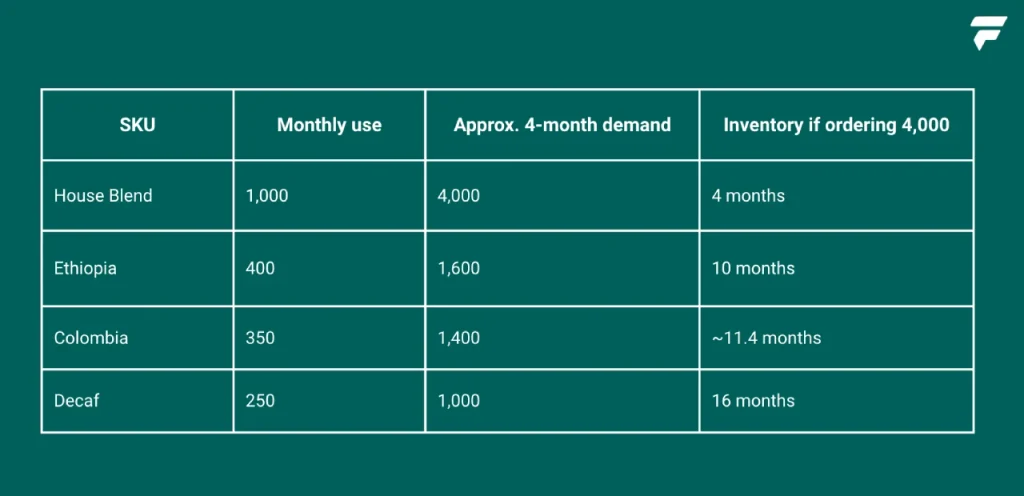
The difference becomes clear if the buyer considers ordering 4,000 bags of every design simply to reach the same production quantity. For the House Blend, 4,000 bags represents four months of demand. For Decaf, the same 4,000 bags represents sixteen months. The production quantity is identical, but the inventory commitment is not. Increasing the House Blend order to access better production economics may be relatively easy to justify because those bags turn over quickly; making the same decision for Decaf could leave more than a year of printed packaging in stock.
The same distinction matters when evaluating printing economics. A roaster using 24,000 bags of one stable design is in a very different production position from a roaster using the same 24,000 bags across four designs. The first project concentrates volume into one production requirement, while the second divides demand among SKUs moving at different speeds. Total annual volume therefore should not be used on its own to decide how each design should be produced or how much should be purchased at one time.
This creates one of the central tensions in custom packaging procurement. Production economics generally improve when quantities become larger and more concentrated, while inventory economics favor quantities that follow the actual sales velocity of each SKU. The most efficient quantity for the factory is therefore not necessarily the most efficient quantity for the coffee roaster. A good purchasing plan has to balance both sides rather than optimize only the cost per bag.
Not every SKU needs the same purchasing strategy either. A core House Blend with stable year-round demand can usually support a larger inventory commitment because additional bags turn over predictably. A slower product such as Decaf may justify a more conservative quantity even if that means accepting a higher packaging cost per bag. A seasonal or rotating single origin is different again: if the coffee itself may only be available for a few months, preserving flexibility can be more valuable than reaching the lowest possible unit cost.
For a multi-SKU roaster, the goal is therefore not to find one ideal order quantity for the entire product range. It may make sense to pursue stronger production economics on stable, fast-moving designs while deliberately keeping slower or short-lived SKUs more flexible. Where specifications allow, different designs may still be coordinated within the same purchasing or production plan, but the quantity of each design should ultimately reflect how quickly that SKU sells and how long the packaging is likely to remain usable.
The real cost of holding too much printed packaging
Holding ten months of custom-printed coffee bags is different from holding ten months of generic packaging. Once a bag carries a specific brand, product name, net weight, artwork, and other product information, its future use is tied to that packaging configuration. Ordering more therefore does more than increase inventory: it commits a larger portion of future sales to the product and packaging decisions being made today.
For an established House Blend with predictable demand and mature branding, that commitment may carry relatively little risk. A new product, seasonal coffee, or changing brand creates a different situation. A redesign, change in net weight, revised product information, regulatory update, or discontinued SKU can leave perfectly usable bags commercially obsolete. If a company orders 10,000 bags to obtain a better unit price but still has 6,000 in stock when the packaging needs to change, the value of those unused bags can easily outweigh the savings achieved through the larger production run.
This is why inventory coverage should also be viewed as exposure to future change. Holding twelve months of a printed bag effectively assumes that sales will remain reasonably close to forecast and that the same packaging will still be suitable when the final bags are used. A buyer considering a larger run should therefore ask not only, “How many months will these bags last?” but also, “How confident are we that this exact packaging will still be usable by then?” The further inventory extends into the future, the more confidence the buyer needs in both demand and packaging stability.
Long inventory coverage is not necessarily a problem. A stable, fast-moving SKU may justify six, nine, or even twelve months of packaging if demand is predictable and the additional production savings are worthwhile. The same inventory period may be difficult to justify for a new launch or rotating single origin. The risk comes not from the number of months alone, but from the amount of uncertainty contained within those months.
Working capital adds another dimension to the decision. Money committed to packaging remains tied up until those bags are consumed, so a larger order should earn its place by creating enough production or purchasing value to justify that additional commitment. For a growing roaster, the same cash may also be needed for green coffee, equipment, marketing, or other operating requirements. The relevant comparison is therefore not simply the unit cost of 2,000 bags versus 5,000 or 10,000, but the savings from the larger run against the additional inventory and working capital required to obtain them.
For custom-printed coffee bags, the lowest unit price is therefore only one part of the cost. A larger run becomes genuinely economical when the production savings are meaningful, the additional bags are likely to turn over comfortably, and the buyer has enough confidence that the packaging will remain usable until they do.
Why first orders and repeat orders need different logic
The economics of a first order are different because many of the assumptions behind the purchase have not yet been tested. A new coffee brand may expect to use 500 bags per month, but actual demand could turn out to be 250 or 900. The artwork may appear final before launch and still need adjustment once the product reaches the market, while one SKU may sell much faster than another. When uncertainty is high, the value of flexibility should therefore carry more weight in the quantity decision. A smaller first run may have a higher unit cost, but it also limits how much inventory is committed before those assumptions have been tested.
For a new coffee brand with no sales history, it is usually more useful to work with a demand range than to rely on a single precise monthly forecast. If a new product could reasonably use 200–400 bags per month, test the proposed order against both ends of that range. An order of 2,000 bags represents about five months of inventory if sales reach 400 bags per month, but ten months if sales settle at 200. Testing both scenarios shows how sensitive the inventory decision is to the sales forecast and gives the buyer a clearer view of the commitment being made before the order is placed.
There can therefore be economic value in paying somewhat more per bag on an uncertain first order. Suppose, purely as an illustration, that the first 1,000 bags cost $0.10 more per bag than they would at a larger production quantity. The immediate premium for keeping that initial commitment smaller is $100. If doing so allows the business to identify a packaging change or a very different sales pattern before several thousand additional bags are printed, that premium has purchased useful flexibility rather than simply increased the packaging cost. The calculation will be different for every project, but the principle is useful: when uncertainty is high, flexibility has an economic value of its own.
The calculation should change once real sales data becomes available. Suppose a company orders 3,000 bags expecting them to last six months, but 900 are still in stock at the end of that period. Actual consumption was 2,100 bags, or about 350 per month, rather than the forecast 500. Reordering another 3,000 simply because that was the previous PO would ignore the most useful information generated by the first order. If instead all 3,000 bags are consumed within three months, actual demand is closer to 1,000 bags per month, providing equally strong evidence that the original purchasing plan was too conservative.
Repeat orders should therefore be recalculated using actual consumption, real replenishment time, remaining inventory, and SKU-level turnover rather than simply copying the previous purchase quantity. Better data may justify a larger production run, but it can just as easily show that the quantity should be reduced or distributed differently among designs. As uncertainty falls, the buyer can make a more deliberate trade-off between production economics and inventory exposure.
The first order therefore does more than put packaging on the shelf. It establishes how the bags perform in the business: how quickly each design turns over, how accurate the original forecast was, and how long replenishment actually takes. That information makes the second purchasing decision fundamentally different from the first—and usually much better informed.
Look beyond one order: What does the year of packaging look like?
A quantity that looks economical on one purchase order may not produce the best result over a full year. Once demand becomes reasonably predictable, it is useful to step back from the individual order and consider how the same packaging will be supplied throughout the year. A roaster using 60,000 bags of one stable design annually could, in theory, purchase 10,000 bags six times, 20,000 bags three times, or 30,000 bags twice. At an average consumption rate of 5,000 bags per month, those options represent roughly two, four, and six months of packaging per order. They are not simply three order quantities; they are three different annual supply plans.
The 10,000-bag option keeps less inventory on hand and preserves more flexibility, but requires six purchasing, production, and shipping cycles during the year. The 30,000-bag option reduces those cycles to two and may offer better production economics, but each order commits roughly six months of demand at once. The 20,000-bag option sits somewhere between them. None is automatically the best choice. The useful comparison is what each pattern does to the business over the full year rather than which individual PO produces the lowest price per bag.
That annual comparison should include the total cost of the bags, the number of production and shipping cycles, average inventory held, working capital committed, and the risk of either running short or carrying packaging that may become obsolete. Logistics can materially change the result as well. A smaller-order strategy that keeps inventory lean but repeatedly forces the buyer to use urgent air freight instead of planned sea freight can erase part of the benefit of carrying less stock. At the other extreme, reducing order frequency has limited value if it leaves large quantities of slow-moving printed packaging in storage.
After several repeat orders, the buyer should have enough information to evaluate not only the next quantity but the purchasing pattern itself. Actual consumption shows how quickly the design turns over; real replenishment history shows how much time needs to be allowed between placing an order and receiving usable stock. Previous shortages and excess inventory also reveal whether the existing order cycle is too aggressive or too conservative.
A business that repeatedly runs short between orders may benefit from increasing its normal production quantity or placing the next PO earlier. One that consistently carries substantial inventory into the next purchasing cycle may need a smaller run, a longer interval between orders, or a different quantity by SKU. The objective is not necessarily to place fewer orders or larger orders. It is to develop a repeatable supply pattern that keeps packaging available when needed without committing more inventory than the business can use efficiently.
As demand becomes more predictable, packaging procurement can therefore evolve from asking “How many bags should we order this time?” to a more useful question: “What ordering pattern gives us the best balance of production economics, inventory, and replenishment risk over the year?”
How to choose the final coffee bag quantity
By the time you request quotations, you do not need to know one perfect order quantity. Start by estimating how much packaging you are likely to consume during the replenishment period and how much printed inventory you are comfortable carrying. That gives you a practical range rather than a single number. Within that range, ask your supplier to quote two or three quantities you could realistically purchase rather than asking for quantities you are unlikely to use simply to reach a lower quoted unit price.
Your supplier can show you how the production economics change at different quantities: the total price, unit cost, applicable printing method, production time, and any quantity or design requirements that affect the quotation. Your own business provides the other half of the decision: monthly consumption by SKU, current inventory, expected replenishment time, available working capital, and confidence that the packaging will remain usable until it is consumed. Neither side of the calculation is enough on its own.
Suppose 2,000 bags provide a substantial cost improvement over 1,000, while moving from 2,000 to 5,000 produces only a modest additional saving but adds another six months of inventory. For that buyer, 2,000 may be the better purchase even though 5,000 has the lower unit price. For a faster-moving SKU, the same three quotations could lead to a completely different decision. At larger volumes, the same logic applies when comparing 10,000, 20,000, or 30,000 bags: the quantity itself matters less than the production savings it creates and how quickly the additional inventory will be consumed.
There is therefore no universal answer to how many custom coffee bags you should order. MOQ tells you where production can start, but it does not determine where you should stop. Your consumption and replenishment cycle establish what is practical, while production economics and your tolerance for inventory exposure determine which quantity within that range makes the most sense. The best purchasing quantity is the point where the additional production savings are still worth the additional inventory commitment.
If you are deciding between several realistic quantities for a custom coffee bag project, send FernPack your bag specifications, number of designs, quantity per design, and approximate monthly usage. We can quote the relevant production options so you can compare the production economics before deciding how much to order.