Sustainable coffee packaging is no longer a niche consideration for specialty roasters. More brands are looking beyond conventional multilayer laminates and exploring recyclable or compostable alternatives, whether to reduce packaging waste, respond to customer expectations, or prepare for changing packaging requirements in the markets where they sell.
The difficult part is that changing the material can affect much more than the sustainability profile of the bag. It may also change how the package seals, how effectively it limits oxygen and moisture exposure, how it behaves during filling, and how well it holds up through storage and distribution. A bag can look perfectly suitable during initial sampling and still behave differently once it is filled with coffee and put into everyday use.
For that reason, the useful question is not simply whether recyclable, compostable, or conventional coffee packaging is “better.” A roaster first needs to understand what the bag will be asked to handle: how the coffee is packed, how long it needs to remain protected, and what conditions it is likely to encounter before reaching the customer.
Once those needs are clear, different material options can be compared on a more meaningful basis. The aim is to improve the sustainability of the package without treating coffee protection as a secondary consideration—or assuming that every material within the same sustainability category will behave in the same way.
Why packaging performance matters for specialty coffee
Roasted coffee continues to change after it leaves the roaster. It releases carbon dioxide while volatile aromatic compounds gradually dissipate, and exposure to oxygen and moisture can accelerate changes in aroma and flavor. Grinding substantially increases the exposed surface area, which is why ground coffee generally requires even more attention to how it is packed and protected.
For specialty coffee, the concern is not simply whether the product remains commercially usable. Much of its value can lie in characteristics such as floral aromatics, fruit notes, acidity, sweetness, and clarity, and these qualities can change during storage before there is anything visibly wrong with the coffee or the package. Different coffees may show those changes differently, but this should not be used to assume that a particular roast level automatically requires a higher or lower barrier material.
From a packaging perspective, the question is whether the finished bag can provide the level of protection the coffee requires. Oxygen and moisture barrier, seal integrity, degassing management, filling conditions, and the storage environment can all influence the result. This is why the material decision needs to begin with the coffee and the way it will actually be packed and sold, rather than with a sustainability label alone.
Why sustainable packaging decisions depend on shelf life and distribution
The amount of protection a coffee bag needs depends partly on how long the coffee is expected to remain in the package and what it will experience during that time. Coffee sold through a roaster’s own café or subscription program may move from production to the customer relatively quickly, while another product may spend considerably longer in transport, warehousing, wholesale distribution, and retail before the bag is opened.
As that journey becomes longer or less controlled, the packaging has more work to do. Temperature and humidity may vary during transport and storage, finished bags may be stacked and handled repeatedly, and the coffee may remain sealed for a longer period before consumption. Under these conditions, consistency in barrier protection, seal integrity, valve attachment, and the physical stability of the bag becomes increasingly important. A weakness that causes little practical concern during a short distribution cycle can become more significant when the same package is expected to perform for several months.
This does not mean recyclable or compostable packaging is only suitable for coffee sold locally, or that exported coffee automatically requires a conventional multilayer laminate. A PE-based mono-material structure with an appropriate barrier, for example, may be suitable for a demanding distribution program if the finished package provides the necessary protection. Conversely, choosing a conventional high-barrier laminate does not by itself guarantee how long a particular coffee will maintain the desired quality.
Packing conditions also belong in the decision. Whole bean and ground coffee do not behave in exactly the same way after roasting, and the time between roasting and sealing affects how much carbon dioxide may still be released after the package is closed. These factors can influence the need for a coffee bag degassing valve and what the bag needs to manage after filling, even when two products are intended for a similar sales period.
Before comparing materials, it is therefore useful to define the real journey of the coffee: how it will be packed, how long it may remain sealed, where it will be sold, and what it is likely to encounter along the way. This gives the material discussion a practical starting point instead of reducing the decision to whether a bag is described as conventional, recyclable, or compostable.
What actually changes between conventional, recyclable, and compostable coffee Bags?
Conventional, recyclable, and compostable coffee bags are often discussed as three distinct packaging categories, but the practical differences lie in how each package is constructed to provide barrier protection, sealing, printability, and the other functions required of the finished bag.
Conventional coffee packaging commonly uses multilayer laminates in which different layers perform different jobs. A structure such as MOPP/VMPET/PE combines an outer layer suitable for printing and surface protection, a metallized barrier layer, and an inner PE layer for sealing. Aluminium foil can also be used as the barrier layer in structures such as MOPP/AL/PE. This approach gives packaging manufacturers considerable flexibility to combine the properties needed for roasted coffee within one laminate.
Recyclable packaging takes a different approach by trying to provide those functions while keeping the package within a material system intended for an appropriate recycling stream. One example is a PE-based structure using EVOH to improve oxygen barrier. The important point is that moving toward a mono-material design does not mean simply removing the barrier layer. Barrier protection still has to be built into the package; it is achieved through a different construction.
Compostable coffee packaging introduces another set of material choices. Depending on the design, kraft paper may be combined with materials such as PBS, PBAT, or PLA, and additional barrier layers can be incorporated where greater protection is required. Whether the finished package qualifies for a particular compostability claim depends on the complete construction and the relevant testing or certification, not simply on the presence of one of these materials.
Each of these approaches can be engineered in different ways. The next step is therefore not to rank the categories from strongest to weakest, but to look more closely at what the specific bag is actually made from and how that construction is expected to perform.
Why material claims alone do not tell you how a coffee bag will perform
Terms such as recyclable, compostable, bio-based, and high barrier can help describe a packaging option, but they do not replace the technical specification of the finished bag. Two coffee bags carrying similar sustainability descriptions may use different barrier layers, sealants, valves, and overall constructions, and those differences can affect how they behave during filling, sealing, storage, and transport.
For a buyer, the useful information depends on what the bag needs to do. If oxygen protection is important, OTR data and the conditions under which it was measured are more informative than the word recyclable or compostable. If the bag needs to run on existing filling equipment, sealing behavior and material handling matter as well. A material description can narrow the options, but it cannot answer these questions on its own.
Kraft appearance does not define the material structure
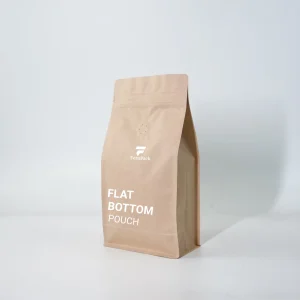
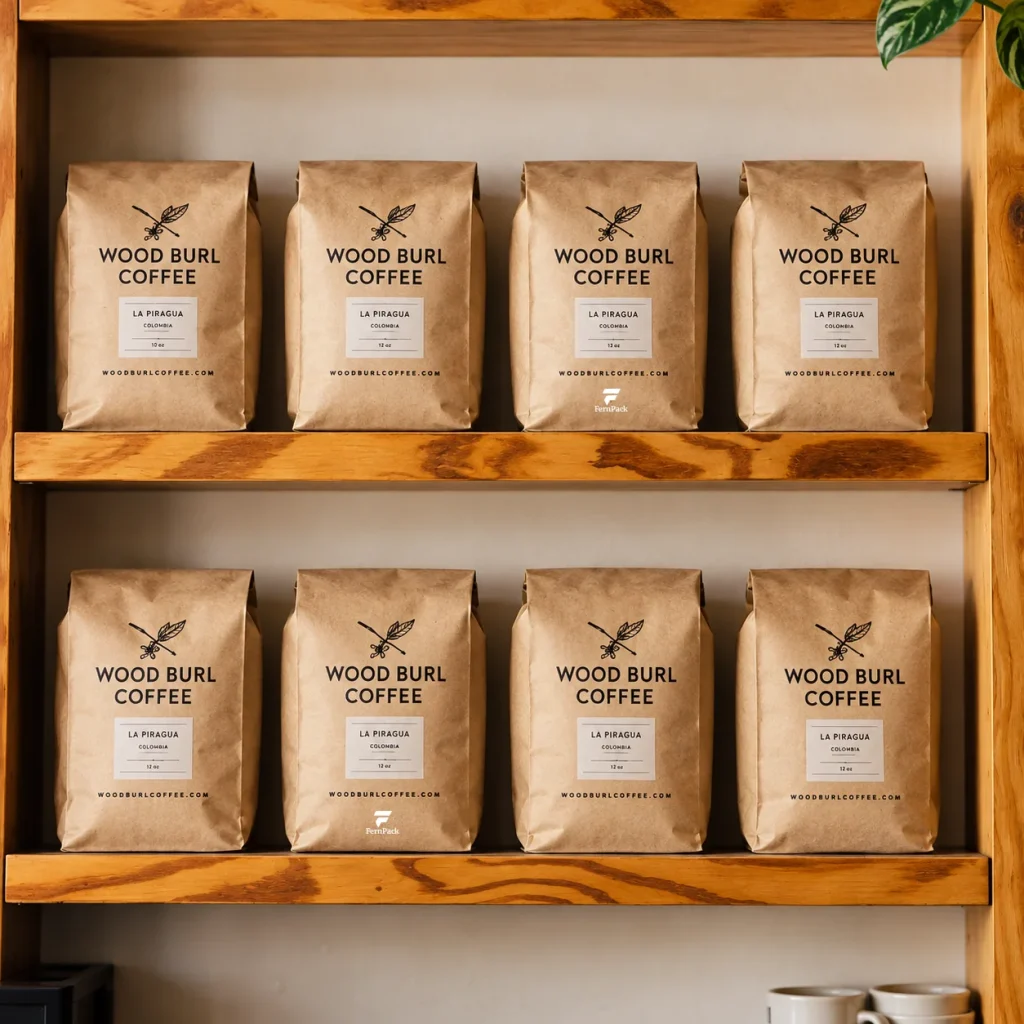
Kraft paper is a good example of how easily appearance and material construction can be confused. Its natural texture has become closely associated with sustainable coffee packaging, but the outside of a kraft coffee bag reveals very little about the layers underneath.
A kraft outer layer can be combined with very different materials. One bag may use kraft as part of a conventional laminate with a metallized barrier and an inner sealing layer, while another may combine kraft with materials selected for a compostable packaging system. The two bags can look similar on the shelf even though their barrier properties, sealing behavior, and intended end-of-life routes are different.
For this reason, descriptions such as kraft coffee bag or paper coffee bag should not be treated as complete material specifications. A buyer needs to know what the full construction is, which layers provide the barrier and sealing functions, and whether a recyclability or compostability claim applies to the finished package rather than only to one component.
The same principle applies beyond kraft packaging. A recyclable bag should not be assumed to have either high or low barrier protection simply because it is recyclable, and a compostable bag should not be assigned a shelf life based on that description alone. Likewise, the term high barrier does not establish how long a particular coffee will maintain the quality a brand expects. Those questions require information about the actual package and the conditions in which it will be used.
Packaging also needs to be considered in relation to the product it protects. Coffee has already required agricultural inputs, processing, transport, and roasting before it reaches the bag. If a packaging change provides inadequate protection and results in more coffee being discarded or reaching customers below the intended quality, improving the end-of-life characteristics of the package has solved only part of the problem. Sustainable packaging therefore needs to address what happens to the package after use without losing sight of what the package needs to protect before that point.
How to test sustainable coffee packaging before switching materials
Changing to a recyclable or compostable structure should be treated as more than a material substitution. An empty sample can confirm dimensions, appearance, and basic handling, but it cannot show everything that will happen once the bag is filled with coffee, sealed, stored, and moved through the normal distribution cycle.
A useful starting point is the technical specification of the proposed material. Where oxygen and moisture protection are important, OTR and WVTR data provide a basis for comparison, but the numbers need to be read together with their test conditions. Standardized methods, such as ASTM D3985 for oxygen transmission and ASTM F1249 for water vapor transmission, help establish how these properties are measured. Film thickness, temperature, relative humidity, and test method can all affect the reported result, so values from different data sheets are not necessarily directly comparable. The objective is not to find the lowest number, but to understand whether the proposed material provides appropriate protection for the coffee and the expected storage period.
The bag should then be tested with the actual packing process. Different material constructions can vary in stiffness, heat response, friction, and sealing behavior, so an empty sample that looks correct may still behave differently during production. For manual packing, these differences may be relatively easy to accommodate. On semi-automatic or automatic equipment, the material also needs to feed, fill, and seal consistently under normal operating conditions. Seal quality should be checked after filling rather than judged only from an unused sample.
The valve and closure system should be part of the same evaluation. A degassing valve does not operate independently of the film around it, and the valve attachment, zipper, and final heat seal all affect package integrity. When the material changes, these components should remain compatible with the new construction and reliable under the expected packing and storage conditions.
Actual coffee should be used for a fill test. This is particularly useful for structured formats such as flat bottom and quad seal bags, where material stiffness and forming behavior influence the appearance and stability of the filled package. The test can reveal whether there is enough working space above the coffee for the zipper and final seal, whether the bottom and side panels form correctly, and whether the bag remains stable during handling and stacking. These details are difficult to judge from an empty sample alone.
If the coffee is expected to remain packaged for an extended period, short-term sample checks should not be treated as shelf-life validation. Test bags can be stored under conditions that reasonably reflect the intended sales and distribution cycle and reviewed at relevant intervals for package integrity as well as changes in aroma and cup quality. When a brand is replacing an established material, keeping coffee in the current package under the same conditions provides a useful benchmark for comparison.
Distribution should be considered in proportion to the way the coffee is actually sold. A direct-to-consumer order shipped shortly after roasting does not experience the same journey as coffee transported internationally, stored by a distributor, and later placed into retail. It may not be practical to reproduce every transport condition before launch, but the test should cover the risks that matter to the business rather than stopping at a few days of observation in the roastery.
The goal is not to prove that a new material behaves identically to the structure it replaces. It is to confirm that the bag can be filled and sealed consistently, protect the coffee for the required period, and remain functional through the distribution conditions it is expected to encounter.
Why a phased transition can reduce packaging risk
Even when a new material performs well during initial testing, moving the entire packaging program at once can create unnecessary risk. Samples and small fill tests answer many questions, but a normal production run introduces larger quantities, repeated handling, routine packing speeds, and the variations that come with day-to-day production.
A practical next step is to use the new structure in a limited production run that represents normal operating conditions. The starting product should be representative of how the packaging will usually be used rather than simply being the smallest or least important SKU. Bag format, filling method, expected storage period, and distribution route can all help determine whether the trial reflects the wider packaging program.
This stage can reveal issues that are difficult to see in small sample quantities and gives the roaster room to make adjustments before committing more packaging inventory to the change. If several coffees already share the same bag specification and operating conditions, there is no need to create a separate transition for every SKU; the purpose is to control the exposure to an unproven change, not to make the packaging program more complicated.
Once the new structure has performed consistently in normal production and through the relevant sales and distribution cycle, the brand has a stronger basis for expanding it more broadly. The decision is then supported by experience with the package in use, rather than by a material specification or sample evaluation alone.
How to communicate sustainable coffee packaging accurately
Choosing a recyclable or compostable packaging option is only part of the transition. A coffee brand also needs to decide how that change will be described to customers, particularly when terms such as recyclable, compostable, biodegradable, bio-based, and plastic-free refer to different material characteristics or disposal routes.
These terms should not be used interchangeably. Bio-based content does not automatically make a package biodegradable or compostable, and a compostable package is not necessarily suitable for home composting. Similarly, a paper or kraft appearance does not make a finished coffee bag plastic-free when other materials are used to provide barrier or sealing functions. Any claim should reflect the complete package rather than its appearance or one individual component.
Recyclability also involves more than the material design itself. A package may be designed for a particular recycling stream, while the collection, sorting, and processing options available to consumers vary between markets. This becomes particularly relevant for coffee brands selling across multiple regions, where the same disposal instruction may not be equally useful everywhere.
Compostable packaging requires the same level of clarity. If a package is intended for industrial composting, customers should not be left to assume that it can also be composted at home. Where a claim depends on particular disposal conditions, certification, or collection infrastructure, communicating that information makes the claim more useful rather than simply more cautious.
Broad descriptions such as eco-friendly packaging may sound appealing, but they tell customers relatively little about what the package is or what they should do with it after use. More specific language about the material or intended disposal route, supported by the appropriate documentation where required, gives the customer clearer information and gives the brand a more defensible basis for the claim. Environmental marketing requirements also vary by market, so brands selling internationally should confirm that on-pack claims meet the rules that apply in each destination.
How FernPack evaluates a sustainable coffee packaging project
When a coffee brand approaches FernPack about moving toward recyclable or compostable packaging, we do not begin by simply replacing the current laminate with the nearest material labelled as sustainable. The first step is to understand what the existing package is already doing successfully and what the brand wants to change.
If available, the current bag specification provides a useful reference. Material construction, bag style, dimensions, valve and closure system, and any known barrier data help establish the starting point. We also look at the coffee itself and the packing process: whole bean or ground, pack size, how soon it is normally packed after roasting, whether filling and sealing are manual or automated, and whether existing equipment places particular requirements on the bag.
The next part is understanding how the coffee is sold. Target shelf life, destination market, transport and storage conditions, and the route from roastery to customer all influence what the new package will need to handle. At the same time, the brand’s sustainability objective needs to be clear. A project focused on moving toward a PE-based recyclable design is not the same as one intended to use a compostable packaging system, even when the coffee and bag format are similar.
With that information, suitable material options can be compared against the current package and the requirements of the new project. Where the material change is significant, samples and validation can then be used before the specification is introduced more broadly.
If you are considering a change but do not know the exact laminate of your current coffee bag, that does not prevent the evaluation from starting. A sample of the existing bag, together with its size, coffee format, packing method, expected shelf life, destination market, and the reason you want to change the packaging, can already provide useful context for comparing alternatives.
Discuss Your Packaging Project
Making sustainable coffee packaging work in practice
Sustainable coffee packaging works best when the material decision begins with what the coffee and the supply chain actually require. Define how the coffee will be packed, how long it needs to remain protected, and what it will encounter before reaching the customer; then compare complete packaging constructions rather than relying on material labels alone. By validating the bag before a wider transition and communicating its end-of-life route accurately, coffee brands can make meaningful packaging changes without losing sight of the practical job the package still needs to do.
FAQ: Sustainable coffee packaging for specialty coffee brands
Can recyclable coffee bags provide the same barrier protection as conventional bags?
They can, depending on the specific material construction and the level of protection required. A PE-based mono-material structure can incorporate an EVOH barrier layer, so moving toward recyclable packaging does not necessarily mean giving up oxygen protection. However, the comparison should be based on the actual structure, barrier data, seal integrity, and finished-bag performance rather than on the terms recyclable or conventional alone.
Are compostable coffee bags suitable for long-term coffee storage?
They can be, but compostability alone does not determine shelf-life suitability. Compostable coffee bags can use different barrier layers, sealants, and material combinations, so the complete construction needs to be evaluated against the storage period and distribution conditions required for the coffee. A bag should not be assigned a fixed shelf life simply because it is described as compostable.
Are kraft coffee bags recyclable or compostable?
Not necessarily. Kraft describes the paper component of the package, but a kraft coffee bag may contain additional barrier and sealing layers made from very different materials. Some kraft bags are built as conventional multilayer laminates, while others may be designed as part of a compostable packaging system. The complete material construction needs to be checked before the finished bag is described as recyclable, compostable, or plastic-free.