When a specialty coffee brand starts reviewing its packaging, the conversation often begins with a simple question.
Can we move away from plastic? For some brands, the next step is even more direct: “We want plastic-free coffee packaging.”
The request is understandable. Many coffee brands are under growing pressure to make their packaging choices more consistent with their wider sustainability goals, whether that comes from their own commitments, retailer expectations, or customers asking more questions about what happens to packaging after use. Packaging is also one of the most visible parts of a coffee brand, which makes it difficult to separate the packaging decision from the sustainability story the brand wants to communicate.
The difficulty usually starts when that sustainability goal needs to become an actual packaging specification.
“We want plastic-free” sounds clear enough in a sustainability discussion. But for a buyer trying to source the right packaging, it immediately raises a more practical question: what exactly needs to be different about the package?
That question matters because a sustainability objective and a packaging specification are not necessarily the same thing. A brand may have a clear reason for wanting to move away from conventional plastic, while still needing to define what the new packaging must achieve in terms of product protection, handling, distribution, and end-of-life.
So the starting point is not to decide whether plastic-free packaging is better or worse. It is to understand what the requirement is actually trying to achieve, and then determine what that means for the packaging itself. Before choosing a material or asking a supplier for a quotation, it is worth taking one step back and asking a more basic question: what do we actually mean by “plastic-free”?
Why “Plastic-free” has become a packaging requirement
There is usually a real reason behind a coffee brand’s decision to ask for plastic-free packaging.
A roaster may have spent years building relationships with producers, improving traceability, and communicating a strong commitment to responsible sourcing, only to find that the packaging used for its coffee no longer feels consistent with those values. Another company may be responding to retailer expectations, changing packaging requirements in its target market, or looking for ways to reduce its reliance on conventional fossil-based materials.
For some brands, the motivation is primarily about the resources used to make packaging. They want to move toward renewable or alternative feedstocks and reduce their dependence on fossil resources. For others, the main concern is what happens after the package has been used: whether it can enter an effective recycling or composting system, rather than simply becoming waste. Some brands are also responding to customers who increasingly expect sustainability to be visible not only in how coffee is sourced, but also in how it is packaged.
These motivations can overlap, but they are not necessarily the same objective.
This is where the conversation can become difficult. A brand may use “plastic-free” as a simple way to describe a broader desire to move away from conventional packaging. Another may have a much more specific requirement about the materials that can or cannot be present in the finished package. A third may be primarily concerned with improving the package’s environmental profile at the end of its useful life.
From a procurement perspective, these differences matter. They affect what the buyer needs to ask suppliers, what claims can reasonably be made about the finished packaging, and ultimately which packaging options are worth evaluating. The same sustainability language can therefore lead to very different purchasing requirements once the underlying objective is made explicit.
That is why a plastic-free request is often better treated as the beginning of a packaging conversation rather than the end of one. Before comparing materials or asking suppliers for alternatives, the first step is to understand what the term actually means in the context of the project.
Because “plastic-free” sounds specific, but it can describe very different expectations depending on how the buyer defines it.
What does “Plastic-free” actually mean?
One of the biggest sources of confusion in sustainable packaging is the way different terms are often used as if they describe the same thing. They do not. For a buyer evaluating coffee packaging, the distinction matters because each term describes a different characteristic of the package.
Plastic-free primarily concerns what the packaging is made from. Bio-based describes where the material’s feedstock comes from. Biodegradable describes how a material breaks down under particular environmental conditions, while compostable refers to a more specific end-of-life pathway under defined composting conditions. Recyclable is different again: it describes whether the packaging can be collected, processed, and recovered through an appropriate recycling system.
The European Commission has highlighted this confusion around biobased, biodegradable, and compostable plastics. A material can be made partly or entirely from biological resources without being biodegradable or compostable, while biodegradable or compostable plastics can also be produced from fossil-based feedstocks.
This distinction becomes especially important when these terms are written into a procurement specification. A bio-based plastic is still a plastic. Its feedstock may come from a biological resource, but that does not by itself make the finished material plastic-free. The EU’s Packaging and Packaging Waste Regulation also distinguishes between “plastic” and “biobased plastics,” defining biobased plastics as plastics made from biological resources regardless of whether they are biodegradable.
Biodegradable and compostable require the same level of care. A material may be biodegradable without being plastic-free, because biodegradability describes what happens to the material under certain conditions rather than what the material is made from. Compostability is more specific, but even here the intended disposal environment matters. Packaging designed for controlled industrial composting should not automatically be described as suitable for home composting; these are different end-of-life conditions and should be specified accordingly.
Recyclability represents another completely different approach. A recyclable package can still contain plastic. In that case, the sustainability strategy is not to eliminate plastic from the packaging, but to design the package so that its materials can be effectively recovered through an appropriate recycling system. The practical differences between these two end-of-life approaches are explored in more detail in our guide to compostable vs recyclable coffee bags.
For a professional buyer, these distinctions are not simply about using the correct terminology. They determine what the supplier needs to provide, what the finished package can legitimately be described as, and what kind of end-of-life pathway the brand is actually asking for. If the objective is to eliminate plastic altogether, the procurement requirement needs to say that clearly. If the objective is to reduce reliance on fossil-based resources, a different set of criteria may be more appropriate. If the objective is better end-of-life recovery, recyclability or compostability may be more relevant than the term plastic-free itself.
This is why the material label should follow the sustainability objective, rather than replace it. Before asking which material is the right choice, the buyer needs to be clear about which characteristic actually matters to the project.
Why the question becomes more complicated with coffee packaging
This is where coffee packaging becomes more complicated than a simple material-selection exercise. A coffee bag has to perform several functions at the same time. It needs to protect the roasted coffee from its surrounding environment, maintain the integrity of the package, withstand filling and transportation, and remain practical during storage and use. Depending on the product and format, it may also need to accommodate degassing and provide a reliable opening and resealing experience.
These requirements exist whether or not sustainability is part of the purchasing decision. Coffee does not respond to packaging claims such as “recyclable,” “compostable,” or “plastic-free.” It responds to the environment that the package creates and maintains around the product.
After roasting, coffee continues to release carbon dioxide, while exposure to oxygen, moisture, and the surrounding environment can gradually affect its sensory characteristics. This becomes particularly important for specialty coffee, where much of the product’s value comes from qualities that a roaster has worked carefully to develop and preserve. Floral aromatics, acidity, sweetness, clarity, and the character associated with a particular origin or processing method can all be part of what the customer is actually buying.
Packaging therefore has a role that goes beyond containing the coffee. It is part of the system that helps preserve the product from the point of filling through transportation, storage, and eventual consumption. For a procurement team, this means that a sustainability requirement cannot be evaluated independently from what the coffee needs the package to do.
This is why the more useful technical question is not simply, “Can we remove plastic?” It is: Can the functions required by the packaging be maintained while meeting the intended sustainability objective?
That question is more complicated because a flexible coffee bag is not usually a single material performing a single job. Its structure may combine different layers and components to provide the properties needed for printing, barrier protection, sealing, strength, and everyday use. Features such as valves, zippers, and other opening or resealing systems can introduce further considerations.
As a result, the appearance of a coffee bag tells a buyer very little about the composition of the complete package. A paper-based outer surface may look very different from a conventional plastic package, but the appearance alone does not establish what materials are used throughout the structure or in its functional components. For a procurement team working with a strict sustainability requirement, the finished package therefore needs to be evaluated as a complete structure rather than judged by its most visible layer.
This leads to an important procurement principle: look beyond the sustainability label and understand the packaging structure, the functions it needs to perform, and whether those functions are consistent with the sustainability requirement.
What are you actually trying to achieve?
Once “plastic-free” has been defined, the next question is why the brand wants it in the first place.
Suppose a brand’s main objective is to reduce its reliance on fossil-based resources. That creates one kind of packaging discussion, focused on where the materials come from and what the brand is actually trying to change. Another brand may be more concerned with what happens after the package is used. In that case, the discussion may move toward recyclability or compostability, together with the collection, processing, and disposal systems available in the markets where the coffee is sold.
A third brand may have a strict corporate requirement that the complete packaging system contain no plastic. That is a different procurement project again, and the requirement needs to be evaluated across the finished package rather than inferred from the appearance or marketing description of one material.
None of these objectives is inherently unreasonable. They are simply different ways of defining what a brand wants its packaging to achieve.
This distinction matters because sustainability discussions often begin with a desired outcome rather than a technical specification. A brand may say, “We want plastic-free packaging,” while the underlying objective could be to move away from conventional fossil-based multilayer packaging, provide a more responsible end-of-life pathway for customers, strengthen the consistency of its sustainability positioning, or reduce the environmental impact of packaging without compromising the quality of the coffee.
Those objectives can lead to very different decision paths. The more clearly a brand defines what it actually wants to change, the easier it becomes to evaluate which packaging requirements are essential and which options are worth considering.
For procurement, this is an important shift in thinking. Instead of starting with the question, “Which plastic-free material should we buy?”, it is more useful to start with, “What outcome do we want this packaging decision to deliver?”
Once that question has a clear answer, the next step is to look at the coffee itself and understand what the packaging still needs to accomplish.
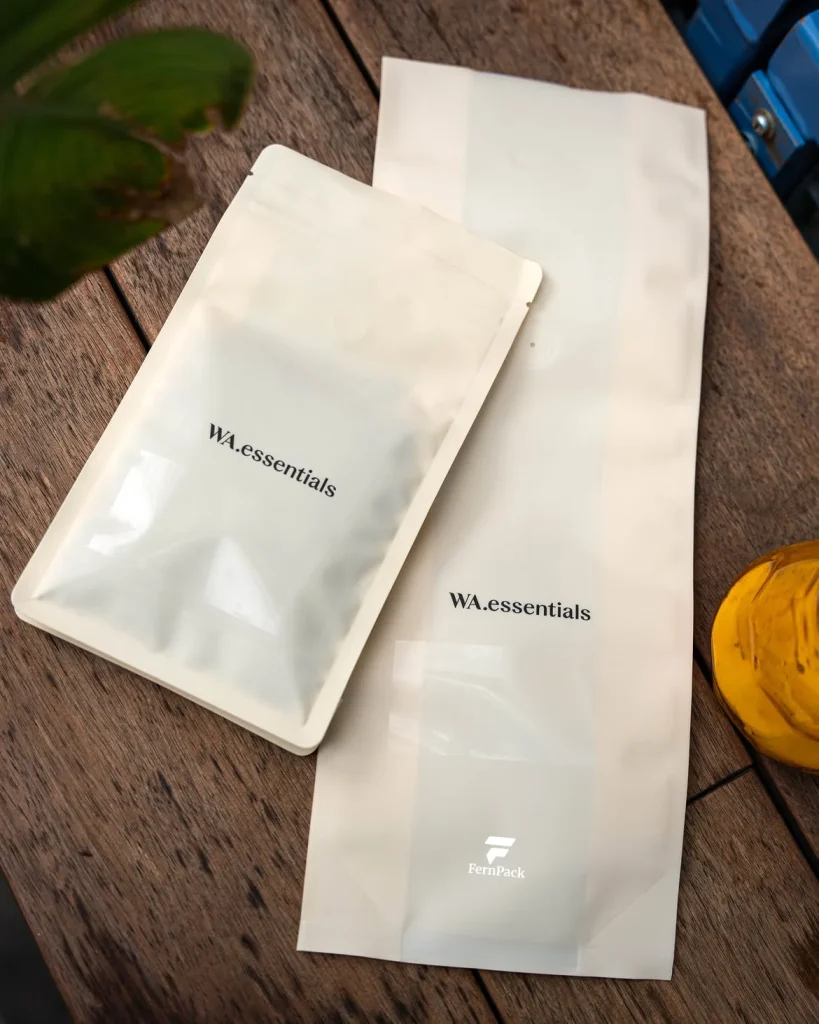
Sustainability goals still have to work with the coffee
Once the sustainability objective has been clarified, the next question is not which material to choose. It is what the packaging actually needs to do for the coffee.
There is no single set of packaging requirements for all specialty coffee. A 250g bag for freshly roasted whole beans sold locally may face very different conditions from a package used for ground coffee that is exported and expected to remain in distribution for an extended period. The same sustainability objective can therefore lead to different packaging requirements depending on the product and the supply chain around it.
Shelf life is one of the first things a buyer needs to consider, but it is not the only one. The form of the coffee, filling process, transportation distance, storage environment, and expected customer use all influence what the package needs to accomplish. Features such as a degassing valve or resealability may be important in one application and less relevant in another.
These considerations do not make sustainability less important. They define the conditions within which the sustainability objective has to work.
This is where the idea of trade-offs becomes important. Sustainable packaging decisions rarely involve finding an option that improves every aspect of the package while leaving everything else unchanged. A brand may decide that maintaining its existing product protection and shelf-life expectation is non-negotiable, while being willing to change the package format, distribution model, or cost structure to achieve a meaningful sustainability improvement elsewhere.
Another brand may have more flexibility because it sells locally, turns inventory quickly, or has fewer requirements around long-distance transportation. It may therefore be willing to consider changes that would be much more difficult for an exporter serving several markets. Neither approach is automatically more sustainable. They simply reflect different business and supply-chain realities.
This is why the question “What are we unwilling to compromise on?” can be just as important as asking what sustainability objective the brand wants to achieve.
A professional procurement decision is not about removing every constraint in the name of sustainability, nor is it about protecting every existing packaging requirement at all costs. It is about understanding which requirements are essential, where the business has room to adapt, and which trade-offs are acceptable in pursuit of the environmental outcome.
There is also a broader reason to look at the packaging decision this way. A packaging material can have a very attractive environmental story and still be a poor fit for a particular application. That does not necessarily make the material unsuitable in general. It means that the environmental value of a packaging choice has to be considered in the context of how the package is actually used.
Packaging is part of a larger product system, and coffee itself has an environmental footprint that extends far beyond the package. Coffee involves agricultural production, processing, transportation, roasting, packaging, and distribution before it reaches the consumer. If a packaging solution does not provide the protection required by the intended supply chain and contributes to significant product loss, the environmental picture becomes more complicated than the sustainability characteristics of the packaging material alone.
This is not an argument for continuing to use conventional plastic without question. It is an argument for evaluating the packaging decision as part of the wider product system. The European Commission makes a similar point in its discussion of bio-based, biodegradable, and compostable plastics, emphasizing that these categories should not automatically be treated as environmentally superior and that their environmental performance needs to be considered in relation to their properties, application, and wider life cycle.
For coffee brands, sustainability should therefore not become a competition over which packaging claim sounds the most responsible. A more useful question is:
Does this packaging solution deliver the environmental improvement we want without creating an unacceptable problem somewhere else in the product’s life cycle?
That question may be harder to answer than simply choosing the strongest sustainability claim. But it leads to a much more responsible procurement decision, because it considers the sustainability objective, the coffee, and the real conditions in which the packaging has to perform as parts of the same system.
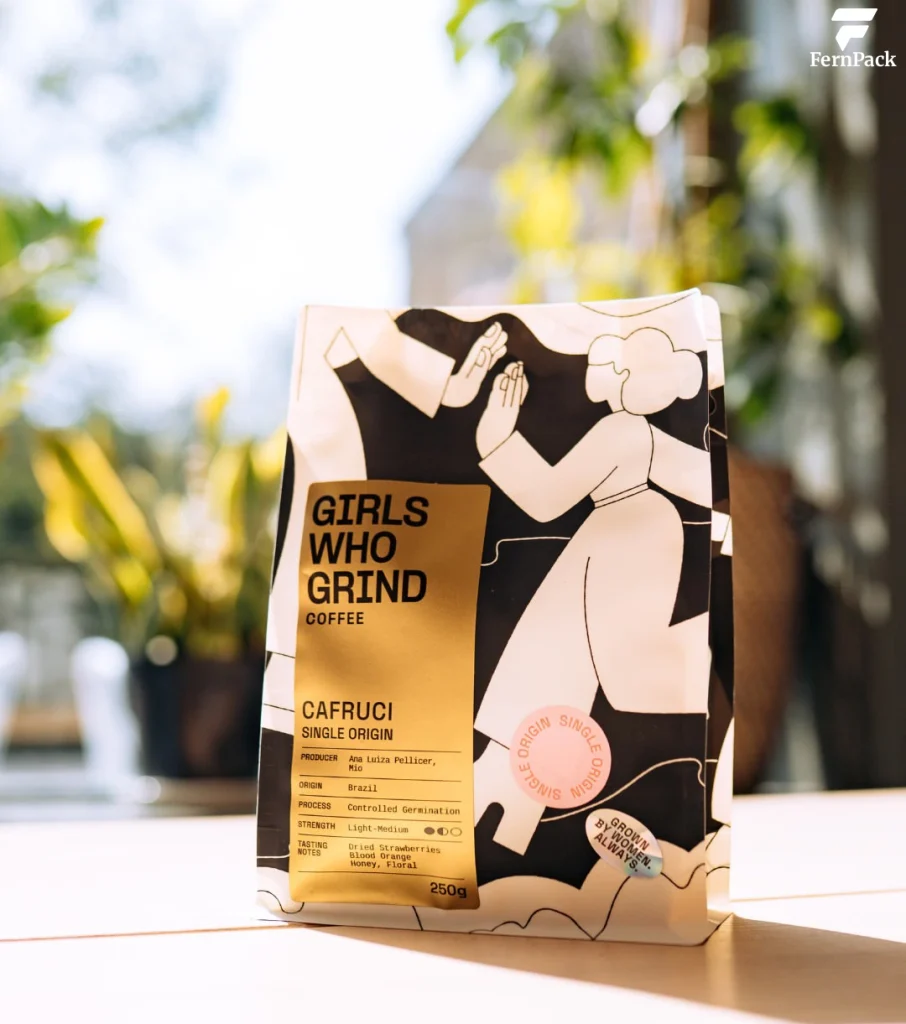
A better way to approach sustainable coffee packaging
The most useful way to approach a plastic-free or lower-impact packaging project is to work backward from the outcome the brand actually wants to achieve, rather than starting with a particular material.
The first step is to make the sustainability objective clear. What does the brand actually want to change? Is the priority to eliminate plastic from the complete package, reduce reliance on fossil-based resources, improve recyclability, support a composting pathway, reduce packaging waste, or pursue a broader environmental goal? The answer does not have to fit neatly into one label, but it does need to be clear enough for the buyer and supplier to evaluate the same objective.
The meaning of “plastic-free” also needs to be agreed at this stage. Does the requirement apply to the complete finished package, including functional components? Are bio-based plastics included in the restriction? Are there specific materials or packaging components that the brand needs to avoid? The stricter the requirement, the more important it becomes to define exactly what is included rather than relying on a general sustainability description.
The next step is to put that objective together with the requirements of the coffee. The buyer should be able to explain the expected shelf life, product format, distribution route, storage conditions, filling process, and the functions the package needs to provide. Just as importantly, the buyer should identify what cannot be compromised and where there is room to adapt. This gives the supplier a practical set of conditions against which different packaging approaches can be evaluated.
End-of-life should be part of the same discussion. If recyclability is the objective, the relevant question is not simply whether the finished package can be described as recyclable, but whether there is a realistic recycling pathway in the markets where the coffee is sold. If compostability is the goal, the buyer needs to understand what type of composting environment the package is intended for and whether that pathway is actually available to the customer. A package designed for industrially controlled composting should not automatically be presented as suitable for home composting simply because it carries the word “compostable.”
When these points are clear, the conversation with a packaging supplier changes significantly.
Instead of saying:
“We need a plastic-free coffee bag. Which material do you have?”
The buyer can provide a much more useful brief:
“This is the environmental outcome we want to achieve. This is the coffee we are packaging and the shelf life we need. This is how the coffee moves through our supply chain. These are the packaging functions we cannot compromise on, and this is the end-of-life pathway we are trying to support. What packaging approaches make sense for this application?”
That is a much more professional procurement brief. It does not require the buyer to know every possible packaging material or technical structure in advance. It simply gives the supplier enough context to evaluate the project against the requirements that actually matter.
This also changes the role of the packaging supplier. The supplier should not simply select a material based on the sustainability label mentioned in the inquiry. A useful packaging discussion should involve understanding the objective, identifying the constraints, clarifying any ambiguous claims, and then evaluating which packaging approaches can realistically bring those requirements together.
Sometimes the result may be a strict plastic-free solution. In another project, the discussion may lead toward a different sustainability objective or a different packaging approach. The important point is not to decide that outcome in advance. It is to make the decision based on a clear understanding of what the brand is trying to achieve and what the coffee and supply chain require.
Going back to the request that started this discussion — “We want plastic-free coffee packaging” — the statement is still a perfectly valid starting point. But by the end of the procurement process, it should have become something more precise: a defined sustainability objective, a clear understanding of the coffee and supply chain, a set of non-negotiable packaging requirements, and a realistic expectation for what happens to the package after use.
At that point, the material is no longer the starting point of the conversation. It becomes one part of a packaging decision that has already been properly defined.
And that is the real purpose of a sustainable packaging specification: not to choose the package with the strongest environmental claim, but to define clearly what the packaging needs to achieve and then evaluate which solution can realistically deliver it.
Where FernPack fits into this decision
At FernPack, we do not see sustainable coffee packaging as a choice between one “green” material and one conventional material.
Different coffee businesses have different sustainability objectives, products, distribution models, and supply-chain requirements. A packaging structure that makes sense for one brand may not be appropriate for another, even when both are equally committed to improving their environmental performance.
Our role is therefore not simply to match a customer with a bag carrying a particular environmental label. It is to understand what the customer is trying to achieve, what the coffee requires from the package, which functions cannot be compromised, and what the intended end-of-life pathway looks like. From there, different packaging approaches can be evaluated against the actual requirements of the project.
Sometimes that may mean comparing different approaches to flexible coffee packaging. In other cases, it may mean taking a closer look at what a sustainability claim actually means before deciding which packaging structure is appropriate. The important point is that the material should be selected as part of the solution, not treated as the solution itself.
For coffee brands working through a sustainable packaging transition, this can make the procurement process more practical. Instead of starting with a material name or a sustainability claim, the conversation can start with the outcome the brand wants to achieve and the requirements the packaging needs to satisfy.
That is where FernPack fits into the decision. Because “plastic-free” is not the end of the packaging conversation. It is often where the more useful conversation begins.