When you start looking for custom coffee bags, you may already know the packaging you want: a flat bottom coffee bag, stand-up pouch, or another format, in a particular size, material, and finish. What you may not know is how the bag should be printed. That is completely normal. Most coffee roasters are focused on their coffee, branding, and packaging design rather than the technical details of commercial printing.
When you request a quotation, your coffee packaging supplier will usually look at the information you provide — including the bag specification, quantity, number of designs, and artwork — and then recommend a suitable printing method.
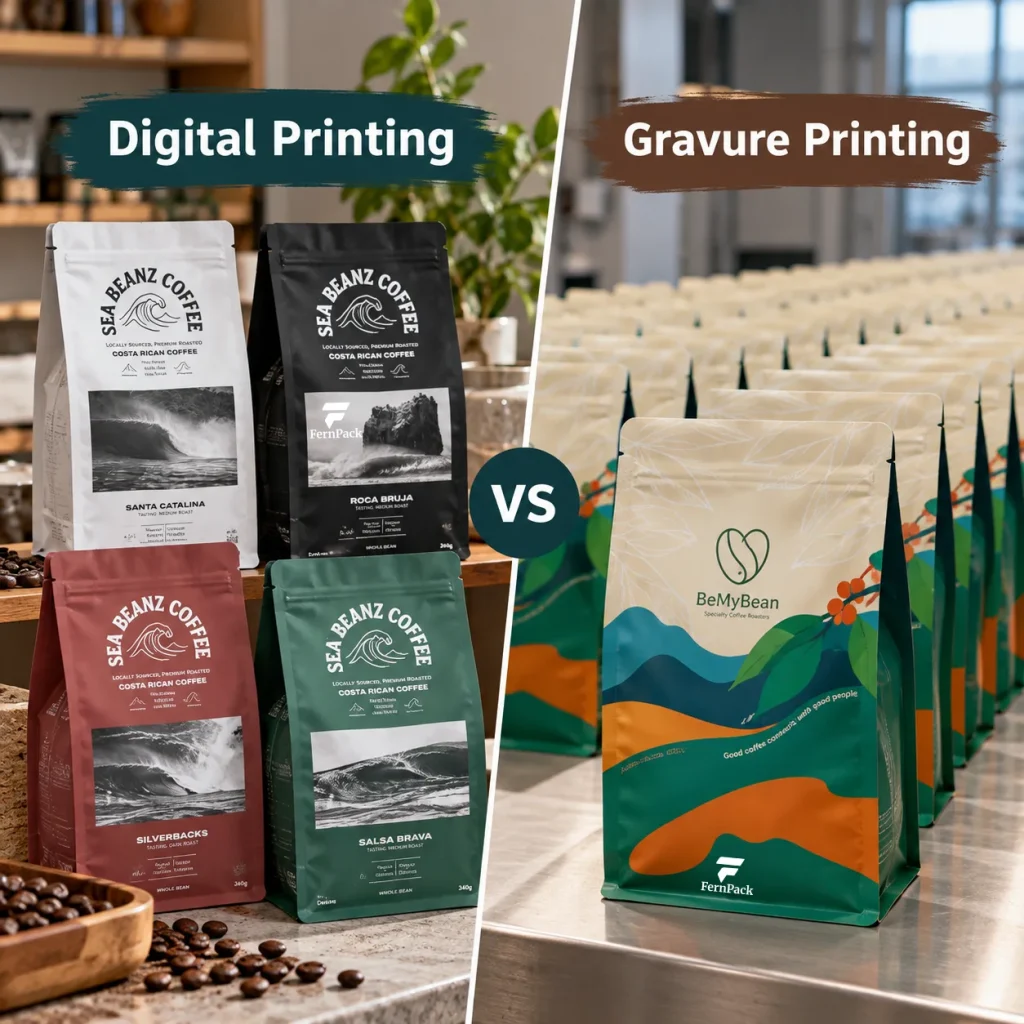
When sourcing custom coffee bags, understanding digital vs gravure printing for coffee bags can help you choose a printing method that fits your order. The two printing methods you are most likely to encounter are digital printing and gravure printing, also known as rotogravure printing. The choice between them is not simply a question of which printing method produces better-looking bags. Both can produce high-quality packaging. The more important question is whether the production economics and flexibility of the method fit your particular order.
A 2,000-bag order divided across three designs is a very different project from 20,000 bags of one established design. Likewise, a small order that will be repeated every few months should be considered differently from a one-time product launch. So when comparing digital and gravure printing for coffee bags, start with your actual purchasing situation, rather than the printing technology itself.
What is digital printing for coffee bags?
Digital printing transfers your artwork directly to the packaging material using a digital printing system. Unlike gravure printing, it does not require engraved printing cylinders for the artwork.
For a coffee roaster, the main benefit is flexibility. You can produce relatively small quantities and, for compatible specifications, divide an order across multiple designs without preparing a separate gravure cylinder set for each design.
For example, a new roaster may need:
800 bags for Ethiopia
700 bags for Colombia
500 bags for a House Blend
That is 2,000 bags in total, but only 500–800 bags of each individual design.
Digital printing is well suited to this type of project because the relatively small quantity per design does not require the same cylinder setup associated with gravure production. It is also useful when artwork is likely to change. If you introduce a new coffee, update your branding, or change information on the packaging for a future production run, the digital artwork can generally be updated without creating a new gravure cylinder.
At FernPack, suitable digital printing projects can start from around 500 bags in total. Multiple designs may be combined when they use compatible specifications, such as the same bag size, material, and finishing requirements. That does not mean every design has a 500-piece minimum. The important distinction is that 500 bags refers to the total order quantity for a suitable project. Different bag sizes or specifications need to be calculated separately.
What is gravure printing for coffee bags?
Gravure printing works differently. Instead of transferring the artwork directly from a digital file, the artwork is engraved onto printing cylinders. The cylinders then transfer ink to the packaging film during production. In a typical gravure setup, each printing color is associated with a dedicated cylinder. The exact cylinder requirement depends on the artwork and printing setup.
This creates an initial setup cost that is not required in the same way with digital printing.
At first, this can make gravure less attractive for a small production run. If you only need a few thousand bags, the cylinder cost represents a relatively large part of the project cost. But the economics change as the quantity per design increases. If you are producing 20,000 or 30,000 bags with the same artwork, the initial cylinder cost is spread across a much larger number of bags. The production cost per bag can therefore become more attractive.
This is why gravure is commonly considered for larger-volume production, particularly when the artwork is stable and the same design will be produced repeatedly.
At FernPack, our typical gravure MOQ is 10,000 bags per design. This is a FernPack production guideline, not a universal industry threshold. The appropriate quantity depends on the bag specification, artwork, number of designs, and purchasing plan.
There is also an important advantage for repeat orders. If the artwork remains unchanged, the original gravure cylinders can normally be reused for subsequent production. In that case, a new cylinder charge is generally not required simply because you are reordering the same design.
Digital vs gravure printing: What actually changes your cost?
The biggest mistake when comparing digital and gravure printing is to look only at the quoted unit price. The more useful question is: What is the total cost of producing the packaging I actually need? Digital and gravure distribute production costs differently.
With digital printing, there is less initial setup associated with the artwork, so the process can work well for smaller quantities. However, the unit production cost may not become as low as gravure at very large volumes.
With gravure, there is an initial cylinder investment. But when a large quantity of one design is produced, that setup cost is spread across many bags and the production economics can become more favorable.
A simple way to think about the difference is:
Digital: lower initial setup + potentially higher unit production cost at larger volumes
Gravure: higher initial setup + potentially lower unit production cost at larger volumes
The actual quotation depends on the bag specification, material, size, printing requirements, finishing, quantity, and other production factors.
This is why a lower unit price does not automatically mean a lower total project cost. For example, suppose you are considering 10,000 bags of one design. The supplier may quote a lower per-bag production price for gravure, but gravure also has the initial cylinder cost. The useful comparison is the total project cost for both options. This is also why MOQ and economical quantity should not be treated as the same thing.
MOQ is not the same as economical quantity
MOQ tells you the minimum quantity a supplier can produce under a particular production method. It does not necessarily tell you the quantity at which the unit cost becomes most attractive. A digital order may be technically possible at 500 bags, for example. But producing 1,000 bags may not cost twice as much because some production costs are relatively fixed.
This creates an important question for buyers: If I can order 500 bags, should I order only 500?
Not necessarily. If your sales volume is uncertain and you want to avoid excess inventory, 500 may be the sensible quantity. But if you are confident that you will use 1,000 bags, it is worth asking the supplier how the total cost changes at the higher quantity.
The same principle applies when comparing digital and gravure.
Do not ask only: “What is your MOQ?”
Also ask: “What is the total cost at my required quantity, and how does it change if I increase the quantity?”
That gives you much more useful information for making a purchasing decision.
Why quantity per design matters
Now consider a customer who says: “I need 10,000 coffee bags.” That information is not enough to properly evaluate the printing method.
The supplier also needs to know how the 10,000 bags are divided.
There is a major difference between:
10,000 bags × 1 design
and:
2,000 bags × 5 designs
Both projects contain 10,000 bags in total. But the printing economics are very different. With one design, the setup cost for gravure can be distributed across 10,000 bags. With five designs, each design requires its own artwork and gravure setup. The total quantity may be large, but the quantity per design is much smaller. This is one of the reasons that quantity per design can be more useful than total quantity when evaluating printing methods.
For digital printing, multiple smaller quantities are generally easier to accommodate, provided the designs share compatible specifications. For gravure printing, the number of designs becomes an important part of the cost calculation because each artwork requires its own cylinder preparation.
So when requesting a quotation, don’t simply write: “10,000 bags.” Instead, tell your supplier: “10,000 bags total — 6,000 of Design A, 2,000 of Design B, and 2,000 of Design C.” That single piece of information can significantly improve the accuracy of the recommendation.
Multiple designs are not the same as one large order
Coffee packaging often involves more designs than buyers initially realize. A roaster might have different origins, blends, seasonal coffees, limited releases, decaffeinated coffee, or several product lines.
For a small quantity of each design, digital printing can offer useful flexibility.
For example: 5 designs × 200 bags = 1000 bags total, may be a reasonable digital printing project when the bag specifications are compatible.
But this does not mean that five designs can always be combined regardless of their specifications. If one design requires a different bag size, material, or finishing specification, it needs to be calculated separately.
This is particularly important when customers request quotations from several suppliers. Two suppliers may interpret “5,000 bags with five designs” differently if the quantity distribution and specifications are not clearly provided. The more precise the inquiry, the more meaningful the quotation comparison becomes.
Artwork stability can change the calculation
Quantity is not the only factor. Consider two customers who both need 20,000 bags.
Customer A has one established coffee product and plans to use exactly the same artwork for the next several years.
Customer B is still developing the brand and expects to redesign the packaging within the next few months.
Their printing requirements are not really the same.
For Customer A, the initial investment in gravure cylinders can make more sense because the artwork is stable and the packaging is likely to be produced repeatedly.
For Customer B, the flexibility of digital printing may be more valuable even if the quantity is relatively high.
This is why it is useful to tell your supplier whether the artwork is ready and stable, still being developed, or likely to change between production runs.
A packaging decision should reflect not only how many bags you need today, but also how stable the product and artwork are likely to be.
Color and print quality
Color is another area where the comparison is sometimes oversimplified. It would be misleading to say that digital printing is simply “better” or that gravure always produces better colors.
Both processes can produce high-quality coffee packaging when the artwork is properly prepared and the color requirements are clearly communicated.
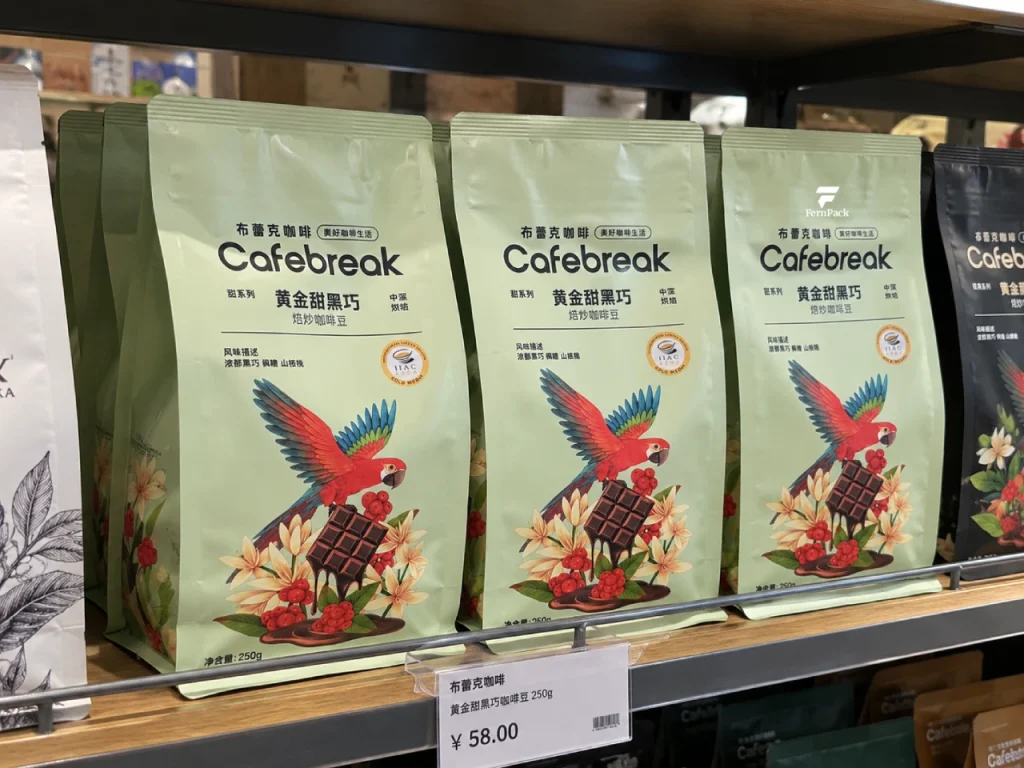
For important brand colors, Pantone references or physical packaging samples can be used as references for color matching. Gravure printing can provide strong color consistency during high-volume repeat production because the same cylinders are used for the same artwork. Digital printing is also capable of reproducing complex, multi-color artwork without requiring a separate gravure cylinder for every printing color.
For a coffee brand, the more practical question is therefore not which technology has “better color,” but:
How important is color consistency to this project, and how will the color standard be established before production?
If a particular green, orange, brown, or other brand color is important, discuss the reference with your supplier before production rather than relying only on the appearance of a screen or PDF file. If your artwork requires specific spot-color treatment or special printing effects, ask your supplier whether these requirements involve additional production costs.
Production time is also part of the decision
Printing method can also affect production timing. At FernPack, typical production lead time is approximately:
Digital printing: 10–15 days,
Gravure printing: 20–30 days
These are typical FernPack production times rather than universal industry standards. Actual timing depends on artwork approval, bag construction, material, finishing requirements, cylinder preparation, and the production schedule.
The difference matters when packaging is connected to a product launch. If a coffee roaster needs a few thousand bags for a new product next month, avoiding unnecessary setup time may be valuable. If the same roaster is planning a long-term production run of a core product, the additional preparation time for gravure may be less important than the overall production economics.
Lead time should therefore be considered together with quantity and cost, rather than as an isolated factor.
How repeat orders change the calculation
This is where the decision can become more interesting. Imagine a coffee roaster initially needs only 3,000 bags. Digital printing may be a practical way to start because the brand is still testing the product and does not want to carry a large inventory. Six months later, the product becomes one of the company’s core coffees. The company now purchases 5,000 bags every two months.
The question has changed. It is no longer simply:
“What printing method should I use for my 5,000-bag order?”
It becomes:
“What printing method makes sense for the way I will purchase this packaging over the next year?”
At this point, it may be useful to compare the annual purchasing pattern. If the artwork remains unchanged and demand is predictable, a larger gravure production run may become worth evaluating.
But this does not automatically mean the customer should buy the entire annual requirement at once. Storage capacity, cash flow, inventory risk, delivery schedules, and the possibility of artwork changes all need to be considered. For this reason, there is no single quantity at which every customer should switch from digital to gravure.
A customer ordering 10,000 bags once is not necessarily in the same situation as a customer ordering 5,000 bags every two months.
Three realistic coffee bag scenarios
2,000 bags across three designs
A new coffee brand is launching three products:
800 bags — Design A
700 bags — Design B
500 bags — Design C
Total: 2,000 bags
The total quantity is 2,000, but no individual design reaches a large production volume.
The brand also does not yet know which coffee will sell fastest. Digital printing would normally be one of the first options to evaluate because it allows the brand to produce relatively small quantities of several designs without the cylinder setup associated with gravure. The brand can also make changes more easily when the packaging is revised for future runs.
10,000 bags of one design
A growing roaster needs:
10,000 bags × 1 design
The artwork is finished and the customer expects the product to sell consistently.
This is a situation where both methods may be worth comparing. Digital printing may still be appropriate if flexibility and shorter production time are important. Gravure is also worth evaluating because the cylinder setup cost is being spread across 10,000 bags of one design.
The supplier should compare the total project cost rather than simply saying:
“10,000 means gravure.”
The customer’s actual quotation will show whether the difference is meaningful for that particular bag specification.
30,000 bags of one stable design
An established coffee company needs:
30,000 bags × 1 design
The product is already selling consistently, the artwork is stable, and the customer expects to reorder the same packaging. This production structure is much more suitable for evaluating gravure seriously. The cylinder investment represents a smaller proportion of the total production volume, while the repeatability of the artwork makes it possible to reuse the cylinders for future orders.
Digital printing may still be technically possible, but the customer should compare the total cost and purchasing requirements of both options.
The point of the example is not that 30,000 is a universal gravure threshold.
It is that high quantity per design + stable artwork + repeat demand creates a very different economic situation from a small multi-design launch.
What information should you give your coffee bag supplier?
You do not need to become a printing expert before requesting a quotation. But you should give your supplier enough information to understand the production structure.
The most useful information includes:
Bag type: flat bottom coffee bag, stand-up pouch, side gusset bag, or another format.
Size: for example, 250g, 340g, 500g, or 1kg, ideally with the required dimensions.
Material: such as kraft laminate, foil laminate, recyclable mono-material, or compostable material.
Quantity: preferably the quantity for each design, not just the total.
Number of designs: especially if several coffee products are involved.
Artwork status: whether the artwork is ready, being developed, or likely to change.
Finishing: zipper, one-way valve, matte or gloss finish, special effects, and other requirements.
Repeat orders: whether you expect to reorder the same packaging regularly.
For example, a useful inquiry could look like this:
We need 5,000 flat bottom coffee bags, 250g, with zipper and one-way valve.
There are three designs: 2,000 / 2,000 / 1,000 bags.
The artwork is ready. We expect to reorder the same bags every 2–3 months.
With this information, a supplier can evaluate the printing method based on your actual project instead of applying a generic MOQ rule.
You can also ask the supplier to compare digital and gravure if your quantity is large enough for both options to be considered.
Ask for the total project cost, not only the unit price.
How FernPack evaluates digital and gravure projects
When preparing a coffee bag quotation, one of the details we often need to clarify is how the total quantity is divided between designs. A customer may initially tell us that they need 10,000 bags. The printing recommendation can change significantly once we know whether those 10,000 bags are one design or five different designs.
At FernPack, we therefore look at the complete production structure before recommending a printing method.
For digital printing, suitable projects can start from around 500 bags in total, and multiple designs can sometimes be combined when the bag size, material, and finishing specifications are compatible.
For gravure printing, our typical MOQ is 10,000 bags per design, with cylinders prepared according to the artwork and printing colors.
If your project sits in a range where either method could be considered, we look at more than the quantity.
We consider:
How many bags are needed for each design?
How many different designs are involved?
Is the artwork stable?
Will the same bags be reordered?
What is the expected purchasing volume over time?
What is the total production cost for each option?
This approach is particularly useful for coffee brands that are growing.
You might start with a few hundred or a few thousand digitally printed bags, then move to larger production quantities as the product becomes established.
Or you may have several low-volume designs that remain better suited to digital printing even though your total annual packaging volume is significant.
There is no need to choose a printing method simply because your order has reached a particular number.
The more useful approach is to look at your quantity per design, artwork stability, repeat purchasing pattern, and total cost together.
If you are planning custom coffee bags and are not sure which printing method fits your project, send your supplier the bag size, material, quantity by design, artwork status, and expected repeat orders.
That is usually enough information to start a meaningful comparison between digital and gravure printing.