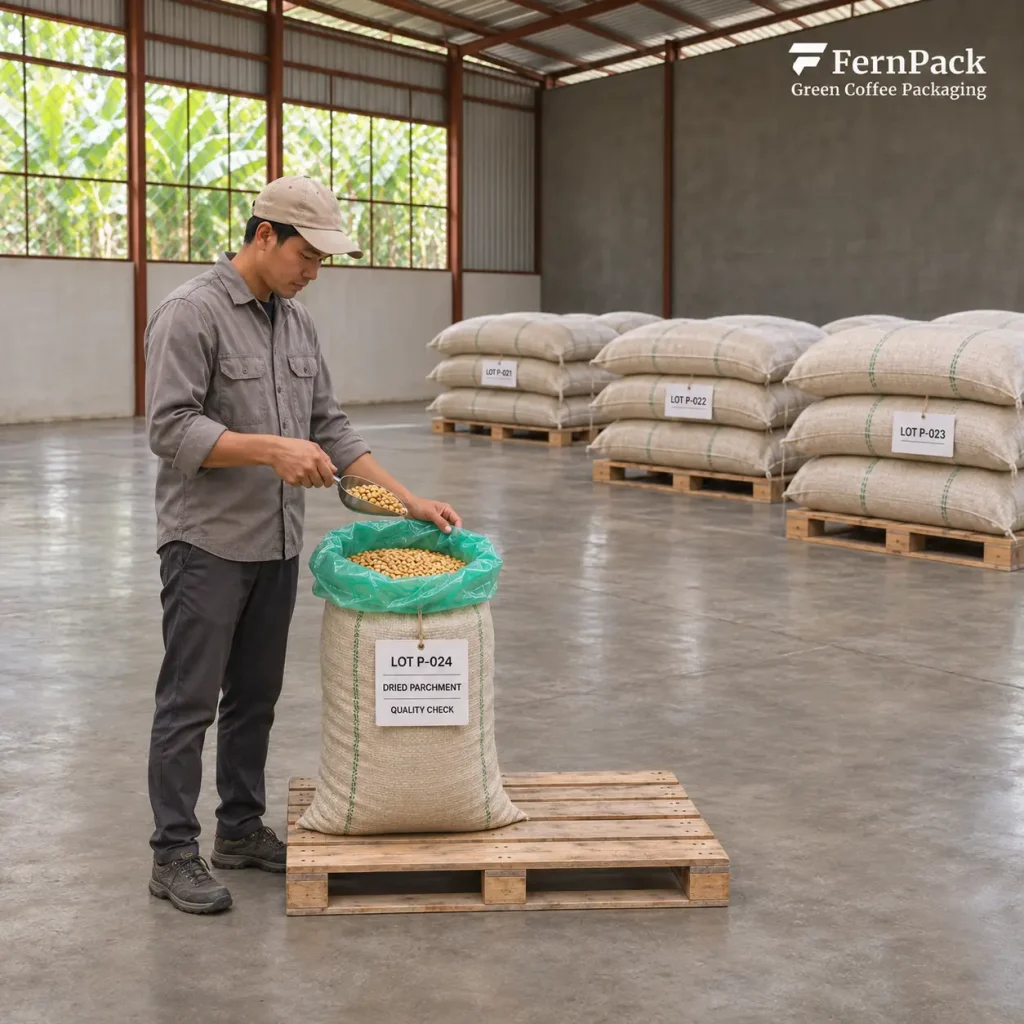
Storing coffee after drying requires a clear plan for moisture checks, packaging, warehouse conditions and lot identification. For producers and cooperatives, the waiting period before milling or collection needs its own management routine to protect quality and keep stock traceable.
A cooperative may finish drying a lot before the buyer confirms collection. A washing station may be waiting for space at the dry mill. A producer may hold parchment while negotiating a sale. In each case, the coffee has entered a waiting period that needs its own management plan.
The essentials are straightforward: accept only coffee that has passed the agreed drying checks, protect it from moisture and contamination, keep each lot identifiable, and set a date for its next review. Packaging supports these controls, but the condition of the coffee at entry determines what there is to preserve.
This guide covers dried parchment coffee, dried whole cherries and hulled green coffee held before milling, sale or dispatch.
1. Identify the coffee form and plan the next operation
Parchment coffee retains the parchment layer around the seed. Dried whole cherries from natural processing retain additional fruit layers until hulling. Hulled green coffee has had these coverings removed.
Record these as separate stock categories. Calling everything “green coffee” in the warehouse ledger hides differences that matter for moisture measurement, milling schedules and available sales quantities.
Keeping washed coffee in parchment can be useful while it awaits milling. A study comparing hulled and unhulled coffee under refrigerated conditions and at 25°C without humidity control found that hulled washed coffee was more sensitive to the uncontrolled environment. This supports considering parchment storage when the sales schedule allows it; it does not establish a universal safe storage period.
Schedule hulling around the next confirmed processing or delivery date. If a buyer needs a finished grade for approval, allow time for milling, grading, sampling and packing. If delivery remains uncertain, consider whether hulling the entire lot now would leave the finished beans waiting unnecessarily.
Parchment and dried fruit coverings do not replace suitable storage conditions. All three forms need inspection and protection throughout the holding period.
2. Check and approve each dried batch before storage
Treat entry into accepted stock as a recorded decision. Identify the batch, confirm its coffee form, and check its condition before stacking it with released coffee.
Codex guidance on preventing ochratoxin A contamination calls for monitoring drying, achieving moisture content below 12.5%, and protecting dried coffee from rewetting. This figure should not be treated as the ideal target for every lot or as proof of quality. Set release criteria using the applicable buyer specification, a suitable measurement method and your validated drying procedure.
Use a moisture meter or laboratory method intended for the material being tested. Do not assume that a setting for hulled green coffee is suitable for parchment or whole dried cherries. Follow the instrument instructions for sample preparation, filling, compression and temperature conditions. If the instrument does not support the coffee form, agree on an appropriate method with the supplier or laboratory.
Record enough information to interpret and repeat the check:
- Batch identity, coffee form and drying completion date.
- Sampling positions and individual moisture readings.
- Instrument, setting, measurement method and reporting basis where applicable.
- Packaging condition and any unusual appearance or odour.
- Acceptance decision, date and responsible person.
Check member deliveries separately before combining accepted material. If one delivery gives inconsistent readings, retain its identity and investigate it. Mixing it with drier coffee makes the original variation harder to locate.
Agree in advance how to handle borderline results. A reading near the release limit should trigger confirmation using the agreed method, including checks on sample temperature and instrument performance. Name the person authorised to approve the batch after that review.
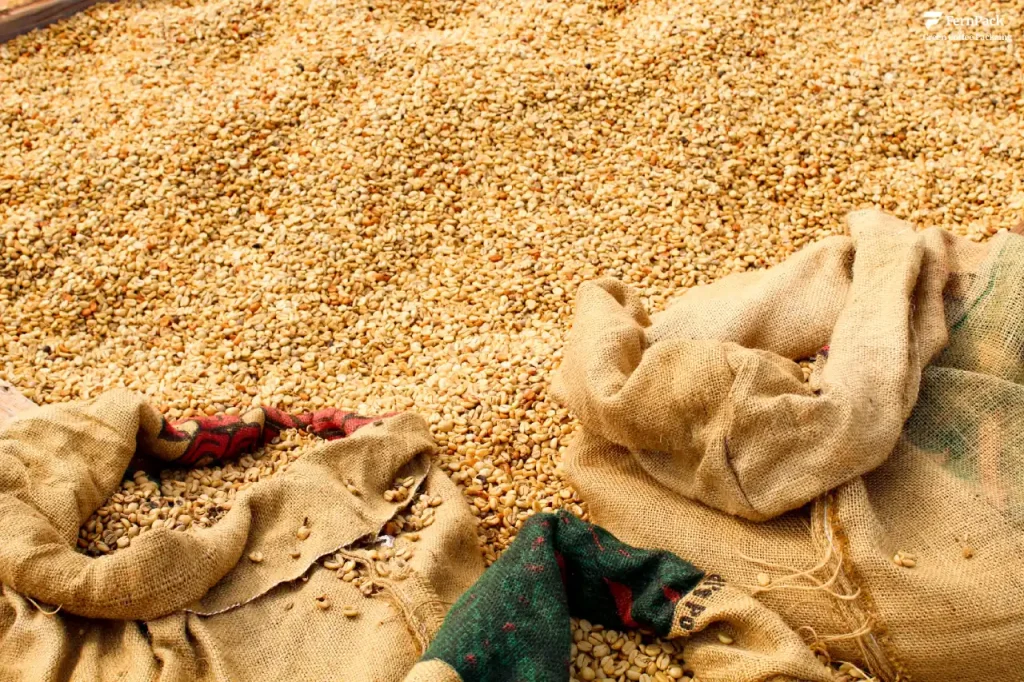
3. Monitor warehouse conditions and respond to changes
Coffee exchanges moisture with surrounding air. FAO’s Arabica Coffee Manual for Lao-PDR (2005) recommends relative humidity below 65% for green coffee stored in jute or woven plastic bags. The Handbook for Sustainable Coffee Production in Malawi, developed under a project led by Imani Development and the Coffee Association of Malawi, gives warehouse design guidance of no more than 22°C and 60% relative humidity. These are context-specific references rather than universal storage limits; the coffee’s initial condition, packaging and exposure time also matter.
For an existing store, begin by recording conditions across the day and during wet weather. Position temperature and humidity sensors near the coffee, including a potentially troublesome area such as an external wall or receiving door. Record sensor locations so that moving a device does not create an unexplained change in the trend.
Use the findings to choose an action:
| Finding | Practical response |
|---|---|
| Humidity rises during receiving | Review rain protection, delivery procedures and how long doors remain open |
| One storage area repeatedly differs from the rest | Check for local moisture entry and move exposed stock while investigating |
| Water droplets or damp surfaces appear | Investigate condensation or leaks and inspect nearby bags |
| Conditions remain unsuitable for the expected wait | Assess building improvements, dehumidification, suitable barrier packaging or transfer to a better store |
Ventilation requires judgment. Outside air can help under suitable conditions, but opening doors during damp weather may introduce moisture. Compare inside and outside temperature and humidity together; relative humidity alone can be misleading when temperatures differ.
Keep coffee away from direct sunlight and heat sources. A sealed liner may reduce moisture exchange, but it does not control warehouse temperature or remove the need to investigate condensation.
4. Build stacks that staff can inspect and move
Use clean, dry, sound pallets and keep bags clear of walls. Before loading, check pallets for contamination, splinters and protruding fasteners that could damage packaging.
Set stack height and arrangement according to the bag system, pallet capacity, floor loading and handling equipment. Leave access to inspect the floor, lower bags and stack perimeter. Lot cards should be readable without climbing or dismantling the stack.
Plan positions before harvest fills the room. Mark pallet locations and access lanes, and reserve accessible positions for lots expected to leave first. Calculate usable capacity after allowing for inspection and movement.
For example, a lot booked for milling next week should not sit behind several unrelated deliveries. Repeatedly moving other bags to reach it increases handling, packaging damage and identification errors. If the milling date changes, update the storage plan as well as the ledger.
5. Keep odours, chemicals and processing debris away
Store coffee separately from fuels, agricultural chemicals, tobacco, spices and other strong-smelling materials. Keep cleaning products and maintenance supplies outside the coffee storage area.
Inspect packaging, pallets and vehicles as well as the room itself. A reused sack or fuel-contaminated pallet can introduce an odour into an otherwise suitable warehouse. Reject unsuitable handling materials before they contact coffee.
Where milling and storage share a building, separate stored coffee from husks, dust and other processing debris. Physical barriers, cleaning arrangements and appropriate dust control should prevent milling activity from contaminating accepted stock.
If a foreign smell appears, record the affected location and hold potentially exposed bags for assessment. Identify and remove the source. Adding a liner after exposure does not establish that the coffee is suitable for sale.
Schedule painting, solvent use and similar maintenance work so that stored coffee is protected.
6. Match packaging to the coffee and handling routine
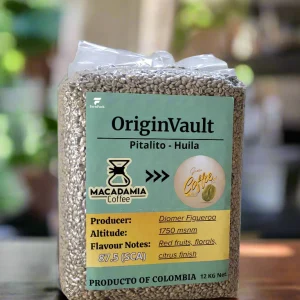
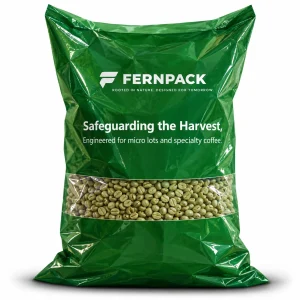
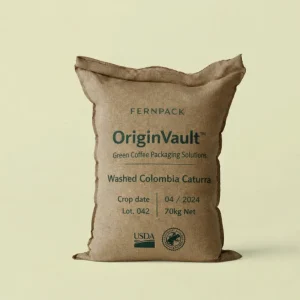
An outer sack provides support during handling. A suitable barrier liner limits moisture and gas transfer according to its material properties. Hermetic storage depends on the integrity and closure of the complete package. Vacuum packing removes air during packing and is not required for every hermetic system.
FernPack’s green coffee packaging guidance treats vacuum packing as an option selected according to the coffee, storage period and packing process.
Before selecting a liner, ask the supplier to confirm suitability for:
- Parchment, dried whole cherries or hulled green coffee.
- Intended fill weight and supporting outer sack.
- Expected storage conditions and duration.
- Available closure equipment.
- Sampling, partial withdrawals and any planned reuse.
Test the packaging through the normal warehouse sequence: filling, closing, moving, stacking and unloading. Inspect the opening, folds and contact points afterwards. A bag that performs well during careful bench filling may behave differently during routine handling.
Leave sufficient space for the specified closure and follow the instructions for the particular product. Do not transfer a tying or sealing method from another bag design without confirmation.
For lots sold in small portions, choose units that limit how much coffee must be opened at each withdrawal. Record openings and reclosures. If a liner is damaged, identify the bag, inspect its contents and replace the packaging as appropriate, retaining the link to the original lot.
7. Keep lot identity separate from release status
Every lot needs an identity and a current status.
Identity explains where the coffee came from and how it was processed. Status tells staff whether it can move to the next operation. Clearly distinguish:
- Incoming coffee awaiting checks.
- Accepted coffee awaiting milling or sale.
- Finished coffee allocated for dispatch.
- Coffee held for investigation.
For a cooperative, the lot record should include the member or delivery reference, processing method, drying batch, coffee form, bag count, net weight and pallet positions. Keep ownership and any certification segregation requirements visible.
When accepted batches are deliberately combined, create a new lot reference and record the contributing quantities. Retain the original delivery records.
After hulling, reconcile input weight with finished grades and processing losses. Parchment inventory weight is not the quantity of exportable green coffee. Give each output grade its own reference linked to the parent lot, so the sales team can allocate the actual stock available.
8. Give inspections a schedule and a clear response
A practical starting routine is a visual check each operating day, a documented stock and packaging review each week, and a scheduled quality review for longer-held coffee. Adjust these intervals to weather, warehouse history and the coffee’s exposure.
During daily checks, look for water entry, stained sacks, loose closures, damaged pallets, spills, pest activity and blocked access. Include pest findings in the site’s integrated pest management programme.
During weekly reviews, identify overdue inspections, unexplained stock movements and delayed departure dates. Increase attention after heavy rain, leaks, packaging damage or prolonged dispatch delays.
Keep investigation samples separate from representative lot samples. If bags beside one wall show staining after rain, mark and hold those bags, inspect neighbouring positions and identify the water source. Combining samples immediately could conceal the local problem.
Define who decides whether coffee can be released. A torn outer sack with an intact liner requires a different assessment from wet coffee or a musty smell. Suspect coffee should remain on hold while the responsible quality team determines the necessary testing and next steps.
Appearance and smell alone do not establish the absence of ochratoxin A. Redrying also does not demonstrate that a suspected contamination problem has been resolved. Record the assessment and release or rejection decision before making the stock available again.
9. Reassess storage when collection or milling is delayed
Arrival order is useful for scheduling, but condition, buyer allocation and the next required operation also matter. Keep investigation priorities separate from commercial dispatch priorities: an older accepted lot may be ready to leave, while a recently received lot exposed to a leak needs immediate assessment.
When a buyer delays collection, assign a new review date and confirm that the storage arrangement still suits the revised wait.
A cooperative expecting collection within a week may instead face several weeks during wetter weather. Before changing only the date in the ledger, review current measurements, bag integrity and available space. Decide whether the lot can remain in place, needs better protection or should move.
Before milling, provide the operator with the lot identity and relevant condition records. Before dispatch, confirm that the actual stock matches the released grade, available quantity, packaging requirements and agreed quality checks. Where a buyer has approved a sample, retain the reference linking that approval to the lot being supplied.
Record partial withdrawals and rebagging so the remaining inventory stays accurate.
A practical storage checklist
Use this checklist as a starting point for a receiving sheet or warehouse routine. Apply it alongside your agreed acceptance criteria, packaging instructions and site procedures.
| Stage | What to confirm | If a problem is found |
|---|---|---|
| Before acceptance | Batch identity, coffee form, drying records, individual moisture readings and condition against agreed acceptance criteria | Keep the batch identified and separate from accepted stock until the checks are complete and an acceptance decision is recorded |
| Before stacking | Clean, suitable and undamaged packaging; correct closure; a clean, dry, sound pallet; and an assigned position with inspection access | Correct packaging, pallet or location issues before stacking. Assess the coffee if damage or exposure may have affected it |
| During storage | Temperature and humidity trends, signs of water entry or condensation, unusual odours, pest activity, bag integrity and clear access | Correct site issues promptly. Identify and place potentially affected coffee on hold, investigate and record the action and release decision |
| When plans change | Revised milling or collection date, current coffee condition, packaging integrity and suitability for the extended holding period | Set a new review date and adjust protection or storage arrangements where needed |
| Before milling or dispatch | Approval for the intended operation, lot identity, bag count and net weight, relevant condition records and applicable quality checks | Resolve discrepancies before routine processing or dispatch. Keep held stock unavailable except for authorised assessment or corrective handling |
Record the inspection date, lot or storage position, findings, action taken and person responsible. For unresolved issues or coffee remaining in storage, assign a follow-up date and record who will confirm completion.
For a small producer, this can begin with numbered lot cards, a notebook, access to a suitable moisture measurement method, temperature and humidity monitoring, and a visual check each operating day. Increase checks after heavy rain, leaks, packaging damage or unexpected delays. A cooperative can use the same approach across member deliveries, warehouse positions and milling outputs.
For packaging planning, share the coffee form, weight per bag, expected storage duration, warehouse conditions and handling method with FernPack. Include how often bags will be opened, the outer sack or other support being used, and which closure equipment is available. These details help identify suitable packaging samples for trials under your team’s actual filling, sealing, stacking and handling conditions.